


An investigative look at the funding architecture behind the Fédération Haïtienne de Football, and where the money goes once it lands in Port-au-Prince.
The Headline Fact That Frames Everything
Haiti just qualified for its second-ever FIFA World Cup — its first since 1974 — and is currently competing at the 2026 tournament across the United States, Mexico, and Canada, having opened with defeats to Scotland and Brazil. That qualification is not just a sporting story. It is a financial event. World Cup qualification converts the FHF, almost overnight, from a federation surviving on modest annual grants into the recipient of a multimillion-dollar windfall — and it does so for a federation that has spent the last five years under direct FIFA receivership, following one of the worst institutional scandals in CONCACAF history.
To understand how the FHF finances itself, you have to hold two facts in tension at once: the funding mechanisms are fairly standard across small football nations (FIFA, CONCACAF, government, sponsorship, competition revenue), but the governance environment in which that money has been allocated is anything but standard. Haiti is the case study other federations get shown when administrators discuss what can go wrong.
1. FIFA Forward: The Backbone Grant
FIFA Forward is not charity in the traditional sense — it’s closer to a development-bank facility that every one of FIFA’s 211 member associations is entitled to draw on, scaled to a common formula rather than to football quality or market size.
How the money is sized. Under FIFA Forward 3.0, launched in January 2023, each member association receives approximately $8 million over a four-year cycle, a sevenfold increase compared to pre-2016 funding levels, following a 29% increase President Infantino announced at the 2022 FIFA Congress. That places the FHF’s baseline FIFA grant at roughly $2 million per year, before any World Cup-specific payments are added.
Where the global money has actually gone. FIFA’s own accounting of the programme shows the bulk of it is infrastructure and operating cost, not glamour spending: around 80% of FIFA Forward investment goes directly to member associations, with over $2.24 billion committed to projects building or modernising football infrastructure, developing domestic competitions, and covering running costs related to administration and governance. For a federation like Haiti’s, that translates concretely into facility upkeep, referee and coaching education, administrative salaries, and domestic league support — the unglamorous plumbing of a federation, not marquee signings or stadium-naming spectacle.
The compliance strings attached. Forward funding is conditional, and the conditions matter enormously for a federation with Haiti’s governance history. Since Forward 2.0’s rollout, associations must ensure principles of anti-discrimination, diversity, accessibility, and human rights are protected in funded projects, and must take measures to safeguard children and minors from potential abuse within football. Every dollar the FHF draws down is tied to FIFA’s ability to certify that the federation is meeting those safeguarding benchmarks — a requirement that, as the next section shows, is not abstract in Haiti’s case.
2. CONCACAF: The Regional Layer (“One Concacaf”)
Below FIFA sits CONCACAF, which runs its own parallel funding pipeline known as the One Concacaf Program — direct cash and in-kind support layered on top of (not instead of) FIFA Forward.
CONCACAF has been explicit that this funding stream now comes with real fiduciary expectations. As member associations continue to receive funding from CONCACAF, FIFA, and other sources — including sponsorships, broadcast opportunities, and matchday revenues — strong financial planning has become increasingly important to meeting growing fiduciary and stewardship responsibilities. In 2026, CONCACAF ran financial-planning workshops specifically built around this: member associations registered delegates who first completed a Finance Fundamentals course through the Concacaf Academy before an in-person workshop in Miami covering budgeting, financial planning, and the One Concacaf Program, including bilateral sessions tailored to each association’s specific needs.
That CONCACAF felt it necessary to put member federations through remedial budgeting training is itself a data point. It tells you the confederation does not assume its member associations — Haiti very much included — have mature internal financial controls by default; it is actively building that capacity from the outside.
CONCACAF’s own funding capacity has grown alongside its commercial business. As far back as 2018, the confederation increased its One Concacaf Funding Program by more than 35% for that year’s edition, as part of its commitment to invest directly in member associations as enablers of the game’s success. Combined with FIFA Forward, this means Haiti’s combined annual baseline support from FIFA and CONCACAF — before government money, sponsorship, or competition revenue — likely sits somewhere in the $2.5–3.5 million range in a typical non-World-Cup year, though the FHF does not publish a fully itemized account that would let an outside observer confirm an exact figure.
3. National Government Subsidies: Episodic, Political, and Headline-Driven
This is the most volatile and most politically charged of the FHF’s funding streams — and the one that has produced the clearest documentary trail in 2026.
Haiti’s government does not fund football through a standing annual line item in the way some larger federations receive guaranteed state subsidies. Instead, funding tends to arrive in discrete, occasion–driven disbursements, usually timed to a qualification milestone or a tournament. The clearest recent example:
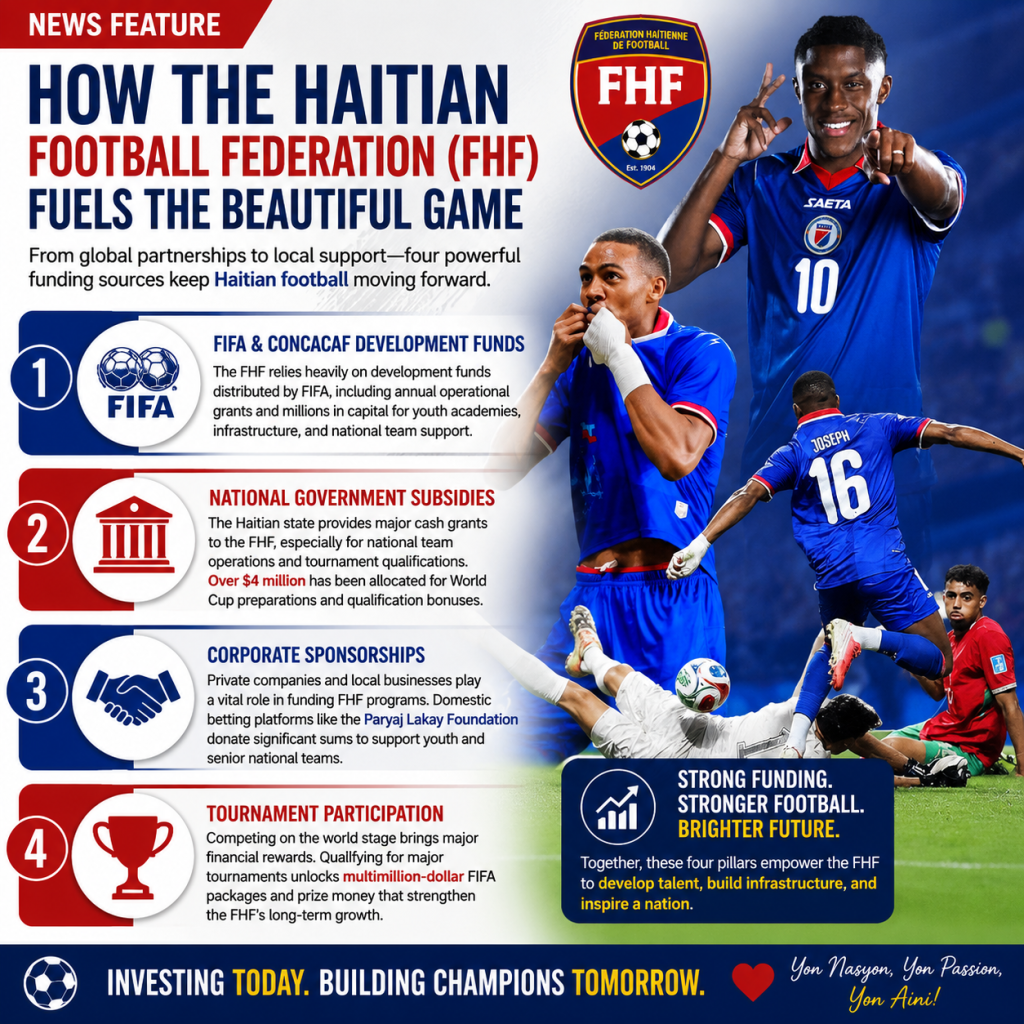
Haiti’s government allocated 528 million gourdes — over $4 million — to the FHF, split between a World Cup qualification bonus and preparation for the 2026 tournament. Half the funding, $2 million, was awarded to the national team as a prize for qualifying for the World Cup, while the remaining $2 million supported training and logistical preparations.
The institutional split here is itself revealing about how Haitian state finance for football actually works: the Prime Minister’s Office funded the qualification bonus, while the Ministry of Youth, Sports and Civic Actions (MJSAC) financed the preparation effort — with officials presenting both checks at a ceremony in Port-au-Prince in April. In other words, there is no single government “sports budget” line writing this check — it is the executive branch (Prime Minister’s Office) covering the prize component, and the sports ministry covering the operational component, as two separate political acts with two separate ceremonial moments.
The framing from officials at that ceremony also captures how explicitly political this category of funding is treated, distinct from FIFA/CONCACAF money, which arrives with technical conditions attached rather than speeches. FHF President Monique André called it not just a check, but “a message of trust, companionship — a message of hope and above all a symbol of a nation that knows its children and still believes in itself,” while the Prime Minister framed continued support for the federation as a civic duty: “It is our responsibility as leaders to keep hope alive and set an example for the country’s future… That is why we are supporting what remains one of Haiti’s greatest sources of pride — Haitian football.”
There is also a longer history of proposed but unrealized state investment that’s worth flagging, because it shows the gap between announced and actual government funding. During the Michel Martelly administration (2011–2016), there was discussion of building a new stadium using funds from the Petrocaribe Fund, but no action was ultimately taken. That pattern — high-profile pledges that don’t convert into disbursed funds — appears repeatedly in Haitian sports-government relations and is a caution against treating any single announced figure as guaranteed cash in hand until it’s actually been transferred.
A historical wrinkle compounds the picture further: in the aftermath of the 2010 earthquake, government and international donor money for football infrastructure became entangled in graft allegations reaching back decades. Duvalier-era investment in Haitian football facilities had allegedly been financed in part by diverted U.S. humanitarian aid — a precedent that still colors how skeptically outside observers read announcements of “government support for football” in Haiti even today.
4. Corporate Sponsorship: Thin, Concentrated, and Telecom-Heavy
This is the weakest and least diversified of the FHF’s five revenue streams, and the one with the least public documentation. Unlike federations in wealthier CONCACAF markets — Mexico or the United States, where broadcast and shirt-sponsorship deals can run into tens of millions annually — Haiti’s corporate sponsorship base is narrow, historically anchored by telecom money, and supplemented by kit-supplier contracts rather than a deep bench of competing brand partners.
The clearest documented commercial deal is the federation’s kit manufacturing agreement: in 2013, the FHF signed a five-year, $1 million contract with Colombian manufacturer Saeta to supply national team kits. That figure — roughly $200,000 per year for jersey rights — gives a useful sense of scale for what “corporate sponsorship” actually means in dollar terms for a federation at Haiti’s level: modest, multi-year, product-and-cash-in-kind deals rather than the nine-figure apparel megadeals seen at larger federations.
Beyond the kit deal, Haiti’s telecommunications sector has historically been the most visible corporate backer of the federation, consistent with a regional pattern across the Caribbean where mobile carriers use national-team sponsorship as a brand-loyalty tool in markets with limited other premium advertising inventory. Reliable, audited figures for the FHF’s current sponsorship portfolio are not publicly published, which is itself notable: corporate sponsorship is the one funding stream in this report where independent verification is genuinely difficult, because — unlike FIFA Forward disbursements or government allocations, which generate press releases and ceremonies — private sponsorship contracts in Haitian football are rarely disclosed in full.
5. Tournament Participation Revenue: Where the Real Money Now Is
For 2026, this category dwarfs every other funding stream combined, and it’s worth walking through exactly how the new FIFA payment structure works, because the numbers are historic.
The baseline guarantee. FIFA’s record-breaking financial package for the 2026 World Cup pays $655 million in prize money across the 48 participating teams, a 50% increase over the previous edition, with each qualified team additionally receiving a preparation payment to cover costs ahead of the tournament. Multiple FIFA-sourced breakdowns converge on the same structure: every qualified nation receives a $2.5 million preparation fee paid before the tournament begins, plus a minimum $10 million qualification/group-stage payment, meaning the true floor for any team — win or lose — is $12.5 million, paid to the national association rather than to players directly.
Haiti’s actual outcome. Having been eliminated in the group stage after losses to Scotland and Brazil, Haiti falls into the tournament’s base payment tier. Teams eliminated in the group stage earn $9 million in performance-based prize money, plus the $2.5 million preparation fee and $10 million qualification payment — a combined minimum of at least $12.5 million flowing directly to the FHF as an organization, not to the federation’s general operating account in some informal sense, but as a formal FIFA-to-member-association payment.
To put that number in context against everything else in this report: a single group-stage World Cup appearance is worth roughly four to six times the FHF’s entire combined annual FIFA Forward and CONCACAF baseline grant funding. This is the structural reason World Cup qualification is treated as an existential financial event for a federation like Haiti’s, not merely a sporting achievement — it can fund years of programming in one disbursement.
The governance question this raises. FIFA pays the prize money to the federation, and it is up to each national federation to determine how much of that money its players, coaching staff, and support personnel actually receive, with the typical player share across federations ranging from 20–30% of the total payout. That discretion is precisely the point at which national federations with weak internal controls — and Haiti’s federation has been under direct external supervision for exactly this kind of concern since 2020 — become flashpoints for player-versus-federation disputes over bonus payments, a recurring pattern across CONCACAF and African federations alike, even if no specific bonus dispute has yet been publicly reported for Haiti’s 2026 squad.
Club Benefits Programme — an adjacent but separate stream. It’s worth noting this money does not go to Haiti at all: FIFA’s Club Benefits Programme compensates the professional clubs that release players for the tournament, with $355 million allocated for 2026 — money that flows to clubs in Europe, MLS, and elsewhere employing Haitian internationals, not to the FHF.
Beyond the World Cup. Tournament revenue isn’t limited to the global stage. CONCACAF’s regional competitions — the Gold Cup, Nations League, and qualifying windows — generate their own participation fees, ticket-revenue shares, and broadcast-distribution payments to participating federations, layered on top of the One Concacaf development grant discussed in Section 2. These are smaller individually but recur annually, unlike the once-every-four-years World Cup windfall.
6. Where the Money Actually Goes: Allocation for the Senior National Teams
Having mapped the inflows, the harder and more opaque question is outflow: how are these funds actually allocated once they reach the FHF? Public, itemized FHF budget documents are not widely available — a transparency gap this report cannot paper over — but the documented allocation patterns that do exist point to a fairly consistent structure:
- Direct team preparation costs. The clearest documented case is the 2026 government allocation itself, where half the $4 million was earmarked specifically for training and logistical preparations ahead of the World Cup, with preparation expected to begin between late May and early June — covering things like training camps, travel, and the logistics of assembling a diaspora-heavy roster spread across clubs in multiple countries.
- Qualification and performance bonuses. The other half of that same government allocation was structured explicitly as a cash bonus to the national team for the achievement of qualifying — a direct performance incentive layered on top of whatever bonus structure FIFA’s own prize money triggers under the federation’s internal player agreements.
- Coaching and technical staff. Both senior national teams operate under internationally recruited coaching staff — Sébastien Migné as men’s national coach and Pia Sundhage as women’s national coach — and that level of coaching talent commands salaries well above domestic market rates, representing a recurring, non-negotiable draw on FIFA Forward and CONCACAF operating funds.
- Infrastructure and training-base costs. Historically, a large share of FIFA’s annual contribution to Haiti was funneled into the federation’s national training center, the so-called “Centre Technique National” or FIFA Goal Centre in Croix-des-Bouquets — a facility housing up to 200 of Haiti’s top young prospects, into which FIFA was reportedly contributing an estimated $1 million per year since 2010. Crucially, this is also the clearest documented case of allocation failure: despite that scale of annual FIFA investment, former coaches described the facility as having fallen into a dilapidated state, with ten children sleeping in each room, no sheets, and no functioning toilets — prompting one coach to ask publicly, “Where did the money go? The federation received millions, and they didn’t even buy sheets.”
- Equipment, kit, and matchday operations. The Saeta apparel contract and similar smaller agreements cover playing kit; FIFA Forward and government preparation funds cover travel, accommodation, and matchday logistics for senior-team friendlies and competitive fixtures.
The honest finding here is that the senior national teams — men’s and women’s — are very likely the single largest line item in the FHF’s budget in any World-Cup-adjacent year, simply because qualification-linked government bonuses, FIFA prize money, and preparation grants are all explicitly tagged to them rather than to grassroots or domestic-league programming. But the federation does not publish a reconciled, audited budget breaking down exactly what percentage of total annual FHF revenue the senior national team program consumes versus youth development, domestic league subvention, refereeing, or administration. Every figure in this section is drawn from specific, sourced disbursements rather than from a comprehensive FHF financial statement — because no such public statement appears to exist in a form accessible to outside researchers.
7. Deep Insight: The FIFA Forward Programme as Haiti’s Real Governance Story
This is where the funding-mechanics story and the institutional-crisis story converge, and it’s the most important thing to understand about FIFA Forward in Haiti specifically: the money has never been the problem. Oversight of the money has been.
The Jean-Bart era and the “ranch”
For roughly two decades, Haitian football’s domestic infrastructure — funded substantially by FIFA Forward and its predecessor programmes — was personally controlled by FHF president Yves Jean-Bart. The Centre Technique National, known informally as “the ranch,” sits in Croix-des-Bouquets, one of Port-au-Prince’s poorest suburbs, on a site originally built as a country mansion where dictator Jean-Claude “Baby Doc” Duvalier hosted his 1980 wedding reception at a reported cost of $5 million. That site became, under FIFA branding, the FIFA Goal Centre — and it was the power base from which Jean-Bart ruled Haitian football for twenty years, until November 2020, when a Guardian investigation led to his being handed a lifetime ban over allegations of sexual abuse of young female players.
FIFA’s own ethics process confirmed the seriousness of the findings: FIFA’s ethics committee concluded that Jean-Bart had “abused his position and sexually harassed and abused various female players, including minors, in violation of the FIFA Code of Ethics.” The ban was later annulled on appeal by the Court of Arbitration for Sport, and Jean-Bart has consistently denied the allegations, pursuing defamation litigation against the journalist who first reported them — a legal fight that Human Rights Watch has characterized as part of a broader pattern of witness intimidation, including armed men confronting witnesses at their workplaces and threats against victims, journalists, and family members. The underlying facts remain legally contested even now, but the financial-oversight story stands independent of how that contest resolves: FIFA money flowed into a facility for two decades with apparently minimal independent verification of how it was being spent or how the young athletes living there were being treated.
Why this matters for “deep insight” into FIFA Forward specifically
The Jean-Bart case is the clearest illustration anywhere in CONCACAF of FIFA Forward’s structural weak point: the programme is designed around disbursement formulas, not destination audits. FIFA’s own promotional materials describe Forward in terms of equity and scale — “a sevenfold increase of money that goes where it has to go: into solidarity projects, football development projects” — but the Haiti case shows that “goes where it has to go” historically meant “goes to the federation president’s discretion,” with FIFA’s headquarters in Zurich relying heavily on the member association’s own reporting rather than independent verification.
That gap is precisely why FIFA’s response to the Jean-Bart scandal was not merely to ban an individual, but to suspend the federation’s self-governance entirely. Since December 2020, Haiti has been run by a FIFA-appointed normalisation committee rather than an elected federal council — first chaired by Jacques Letang, then by Luis Hernandez, with Monique André (now FHF president) serving as a committee member throughout before her elevation to chair. FIFA has repeatedly extended that committee’s mandate, citing both the scale of the institutional repair job and Haiti’s broader crisis: the Bureau of the FIFA Council extended the normalisation committee’s mandate, observing that despite some progress, several key tasks remained incomplete, mainly due to COVID-19 and the unprecedented humanitarian and political crisis the country was experiencing. FIFA also moved to address the safeguarding gap directly rather than just the financial one: an advisory panel was set up specifically to assist the normalisation committee on safeguarding, child protection, and the implementation of strategic social projects aimed at safely and permanently developing football in Haiti.
The current arrangement is FIFA Forward under receivership
So the deepest insight about FIFA Forward in Haiti today is this: it is not flowing to an independent, sovereign national federation in the normal sense. It is flowing to a federation whose senior leadership is FIFA’s own appointees, spending FIFA’s own money, under FIFA’s own enhanced safeguarding conditions, reporting back to FIFA’s own oversight structures. Forward funding and FIFA governance intervention have effectively merged into a single instrument in Haiti’s case — which is unusual even by the standards of FIFA’s other normalisation-committee countries, and is the direct, traceable consequence of how badly the previous disbursement-without-verification model failed.
Whether that arrangement produces durable accountability once a normalisation committee eventually hands power back to an elected federal council — and whether the current World Cup-driven cash windfall gets spent any more transparently than the “ranch” money was — is the open question that will determine whether Haiti’s 2026 qualification becomes a genuine institutional turning point or simply this generation’s version of the same unanswered question a former coach asked years ago: where did the money go?
Sources
This report draws on FIFA’s official Inside FIFA portal and Forward Report; CONCACAF’s official website and partnership/financial-planning communications; Wikipedia entries on the FHF and the Haiti national football team (cross-checked against primary reporting); The Guardian’s investigation as syndicated via the Canada-Haiti Information Project and the Trinidad and Tobago Olympic Committee; CNN; and multiple 2026 financial breakdowns of FIFA World Cup prize money (NBC, FanDuel Research, Yahoo Sports, Fortune, beIN Sports, Bleap Finance, World in Sport). Several figures — particularly the FHF’s exact annual sponsorship revenue and a fully reconciled, audited internal budget — are not publicly available in any source identified, and that absence is itself a finding of this report.


