


An Analytical Report
Prepared July 2026 | By an Expert in Haitian Sports and Development
Executive Summary
Haiti qualified for the 2026 FIFA World Cup — its first since 1974 — and played on the world’s biggest sporting stage against Scotland, Brazil, and Morocco this summer. It did so while gang violence was killing more than 5,500 people a year, while real GDP was contracting for a seventh consecutive year, and while roughly 49% of the population lived on less than $3 per day. The gap between those two realities is not a paradox. It is the central analytical problem this report addresses.
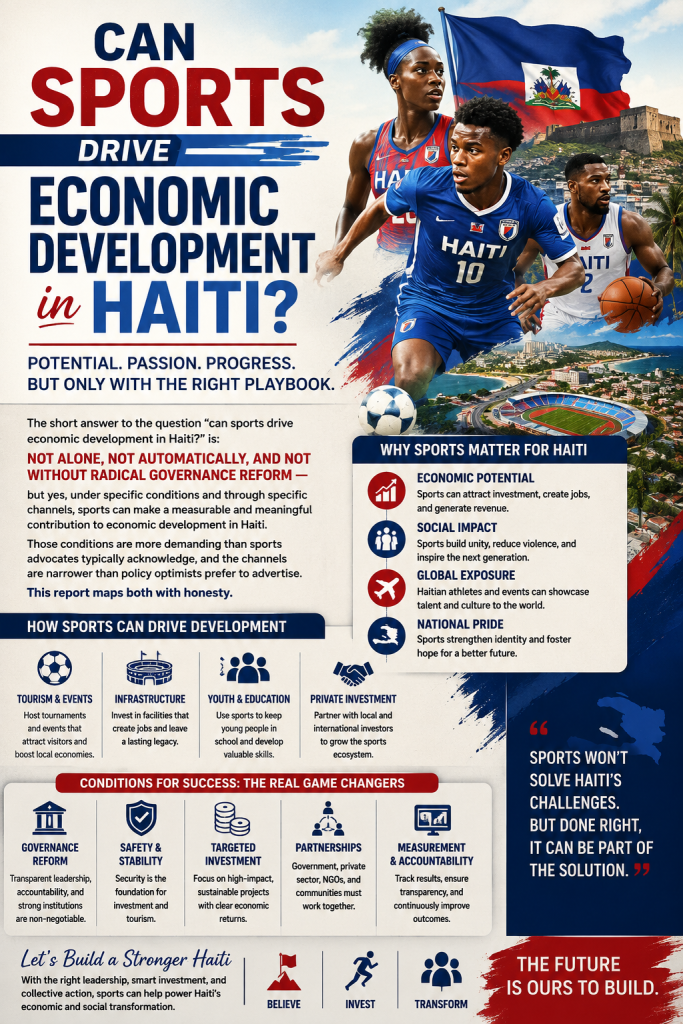
The short answer to the question “can sports drive economic development in Haiti?” is: not alone, not automatically, and not without radical governance reform — but yes, under specific conditions and through specific channels, sports can make a measurable and meaningful contribution to economic development in Haiti. Those conditions are more demanding than sports advocates typically acknowledge, and the channels are narrower than policy optimists prefer to advertise. This report maps both with honesty.
Part I: The Starting Point — Haiti’s Economic Reality
Before asking what sports can do, we must be clear about what Haiti is dealing with. The numbers are stark.
Haiti remains the poorest country in Latin America and the Caribbean, and among the poorest in the world. Its economy has contracted for seven consecutive years as of 2025, with real GDP falling 2.7% in 2025 alone, following a 4.2% decline in fiscal year 2024. Inflation averaged 28.3% in 2025, driven primarily by food and housing costs that hit the poorest households hardest. Government revenue has collapsed to just 4.8% of GDP — one of the lowest tax-collection rates in the hemisphere, and a fraction of the roughly 21.5% average for other Latin American and Caribbean countries. The country’s HDI score of 0.554 places it 166th out of 193 countries globally.
The structural driver of economic activity in this environment is not investment, not exports, and not government spending. It is remittances. Haitian diaspora transfers totaled approximately $4.2 billion in 2024 — representing roughly 16 to 21% of GDP depending on the measurement base — a figure four times greater than the country’s exports and nearly 100 times larger than foreign direct investment. These remittances are the largest single source of foreign exchange Haiti has, and they are also overwhelmingly spent on immediate consumption: food, school fees, and healthcare rather than productive investment.
Into this environment, the question of sports-as-economic-development is not a frivolous one. But it has to be asked honestly, against a backdrop where gangs control large parts of the capital, more than 1.4 million people are internally displaced, 900 schools remain closed, and the port receiving 80% of international trade is periodically blockaded by armed groups. Any discussion of sports driving development that doesn’t center this security reality is not serious analysis.
Part II: What Sports Actually Does in Haiti Today
2.1 Football as the Dominant Sports Economy
Football is not merely Haiti’s most popular sport — it is, by a wide margin, the country’s only sports sector with any meaningful economic footprint. The Ligue Haïtienne, the country’s top domestic league, operates in genuinely difficult conditions: low gate revenues, minimal broadcast rights income, no significant domestic title sponsorship, and a persistent talent-drain as the best players emigrate to professional leagues in Europe and North America. The economic return to Haiti from its own top football league is modest at best.
What has generated real money is international football performance — and the 2026 World Cup qualification is the clearest example yet of how that works. FIFA’s prize structure guarantees every group-stage participant at least $12.5 million: $2.5 million in preparation fees plus $10 million for participation. For a country whose government collects tax revenue equal to roughly 4.8% of a roughly $20 billion GDP — approximately $960 million — a single World Cup appearance represents a windfall equivalent to more than 1% of national tax revenues, paid to the federation rather than to the state, but representing genuine hard-currency inflow. The Haitian government’s own $4 million allocation ($2M qualification bonus + $2M preparation support) layered on top of FIFA’s prize money shows how World Cup qualification functions as a fiscal event, not just a sporting one.
However — and this caveat is essential — that money flows to the Fédération Haïtienne de Football, not to a general economic multiplier. Whether it circulates into the broader economy depends entirely on how the federation spends it, and Haiti’s federation governance history (explored in the prior report on FHF financing) suggests that historical precedent is not encouraging.
2.2 The Diaspora Dimension: Sports as a Remittance Catalyst
This is perhaps the most underappreciated economic channel in the Haiti sports equation, and it is the one where the 2026 World Cup has demonstrated real, visible impact.
Of Haiti’s 26-player World Cup squad, only one — Woodensky Pierre — plays for a Haitian domestic club. Ten were born in Haiti; twelve were born in France of Haitian parents; others were born in Canada, Switzerland, and the United States. The national team is, in economic terms, a diaspora institution. Its players earn professional salaries in French Ligue 1, Turkish Super League, Belgian Pro League, and MLS clubs — wealth accumulated abroad and, in many cases, partially directed back to Haiti.
When diaspora communities in Boston, New York, Miami, Montreal, and Paris gather to watch Haiti play, the economic activity generated — restaurant spending, merchandise purchases, media subscriptions, community event revenue — circulates primarily in host countries, not in Haiti itself. But the pride and identity reinforcement that comes from a World Cup appearance has a measurable if difficult-to-quantify effect on diaspora engagement with Haiti, including charitable giving, investment interest, and remittance motivation. A study of remittances in post-earthquake Haiti showed that diaspora transfers remained “strong and relatively steady,” even as economic conditions worsened — a resilience that has cultural and emotional drivers, not merely financial ones. Sports success feeds that emotional connection.
The deeper economic potential here is converting the diaspora’s emotional investment in Haitian sports from passive consumption (watching games, buying jerseys) into active investment (funding sports infrastructure, training academies, sports tourism development). That conversion has happened in other Caribbean nations and is theoretically available to Haiti; it requires intentional diaspora investment policy that Haiti has historically lacked, with no formal diaspora engagement framework.
2.3 Sports for Development: The Proven Model
The most rigorously documented case of sports generating economic outcomes in Haiti is not professional football at all. It is the A Ganar (“To Win”) program, backed by a $3.6 million grant from the Inter-American Development Bank’s Multilateral Investment Fund and run in Haiti by Robert “Boby” Duval’s Fondation L’Athlétique d’Haïti.
The programme uses sports not as a commercial enterprise but as a pedagogical tool: participants spend an initial phase developing communication, teamwork, and problem-solving skills through athletic exercises, before transitioning to technical training in trades such as construction, garment manufacturing, and car mechanics, and ultimately to internships in businesses, NGOs, and local government. An external evaluation of the pilot programme across its first 6,000 participants in 10 countries found that 78% of those who enrolled graduated, and of those completing the full 240 hours of training, 68% found jobs, went back to school, or started their own businesses. Those are outcomes that many conventional vocational training programmes would envy.
Duval’s description of A Ganar as “the missing link” in helping young Haitians transition into the workplace captures exactly why the sports-for-development model matters in a context where formal labor markets barely function: it addresses the psychosocial gap — self-esteem, discipline, resilience — that disadvantaged Haitian youth face, not just the technical skills gap. In a country where approximately 90% of workers are informally employed in precarious jobs and where youth unemployment and gang recruitment are tightly correlated, that psychosocial function has economic value that is real but notoriously hard to capture in GDP statistics.
2.4 The Informal Sports Economy
Below the level of formal programmes and international competition sits an informal sports economy that is economically invisible but socially significant. Street football, local basketball courts, neighborhood tournaments, and community athletic events in Haiti generate informal economic activity — small vendors, equipment rentals, informal coaching, local transport — that provides livelihoods to thousands of Haitians in communities where formal employment is essentially absent. This informal layer is not trivial; it is where most Haitian sport actually happens, and it is the layer most vulnerable to gang violence, which closes courts and pitches with the same lethal efficiency it applies to schools and markets.
Part III: The Five Channels Through Which Sports Can Drive Development
Having mapped what sports currently does in Haiti, we can now analyze the five distinct channels through which a more intentional sports development strategy could generate economic returns.
Channel 1: Human Capital Formation (Highest Potential)
The A Ganar evidence demonstrates that sports-for-development programmes can improve labor market outcomes for disadvantaged youth. Scaling that model nationally would require institutional investment — trained coaches who are also certified vocational instructors, physical infrastructure beyond Port-au-Prince, and coordination with private sector employers willing to absorb interns and graduates. The cost-benefit case is strong: the IDB’s own evaluation suggests the cost per successful outcome is competitive with conventional vocational programs, and the behavioral co-benefits (reduced gang recruitment, improved school retention) add social returns that aren’t captured in employment statistics alone.
Haiti’s young population — over 60% under age 25 — is the structural precondition for this channel to matter at scale. The country’s demographic dividend can only be realized if young people have skills and pathways to formal employment. Sports-for-development is not a substitute for education reform, but it can serve as a bridge for the estimated hundreds of thousands of Haitian youth currently outside both school and the formal economy.
Channel 2: Diaspora Remittance Mobilization (High Potential, Underutilized)
With $4.2 billion in diaspora remittances flowing into Haiti annually — currently going 80%+ to immediate consumption — the strategic question is whether sports success can shift even a fraction of that toward productive investment in sports infrastructure, academies, and related services.
The Dominican Republic, Haiti’s neighbor, has done exactly this in baseball: MLB academies in the Dominican Republic represent hundreds of millions of dollars of foreign investment in training facilities, nutrition, coaching, and youth development, with multiplier effects on local employment and the construction sector. Baseball academies now dot the DR’s landscape, creating a pipeline of talent that generates transfer fees back to Dominican clubs and income opportunities for coaches, trainers, physiotherapists, nutritionists, and support staff. Haiti has the football talent to replicate this model — the 2026 World Cup squad itself is proof — but it lacks the domestic infrastructure to capture the value. Twelve of the 26 players in Haiti’s squad were developed through the French football system, not Haiti’s. That is talent Haiti produced biologically but could not develop institutionally. Each elite player developed in France rather than Haiti represents a potential transfer fee — often worth millions of euros — that would have flowed to a Haitian club if the infrastructure had existed to develop them locally.
Channel 3: Sports Tourism (Medium Potential, Long Time Horizon)
Before gang violence made large parts of Port-au-Prince inaccessible, Haiti had meaningful tourism assets: beaches, mountains, cultural heritage, and the energy of Caribbean sports culture. Several northern cities — Cap-Haïtien, Jacmel — retain potential as regional sports tourism destinations once security conditions permit.
Sports tourism in the Caribbean has proven to be a real economic driver for smaller nations: the Caribbean Premier League (CPL) in cricket, CONCACAF tournaments hosted in multiple island nations, and regional athletics meets all generate hotel occupancy, restaurant revenue, transport spending, and visibility benefits that outlast the events themselves. Haiti is a founding member of CONCACAF, has a legitimate football culture that predates that of most Caribbean neighbors, and could plausibly develop a regional role as a football training hub or tournament host — but not until security conditions allow international visitors to move freely, and not without sustained investment in hospitality and transport infrastructure that currently does not exist.
The 2026 World Cup demonstrated the inversion of this dynamic: U.S. travel bans and economic exclusion meant that Haitian fans couldn’t even attend their own team’s matches. At $2,100 per ticket to the Scotland game alone, Haitian-Americans in Boston couldn’t afford to go. The World Cup generated zero direct tourism receipts for Haiti while generating enormous pride and soft-power visibility — the symbolic benefit of international sports without any of the economic return normally associated with fan travel.
Channel 4: Athlete Transfer Fees and Salary Remittances (Real but Currently Leaking)
Professional athletes from Haiti are a financial asset that Haiti is currently not capturing. When a player developed in the French academy system goes to a Belgian club for €3 million, that transfer fee goes to the French club, not to any Haitian institution. When that same player earns a professional salary in Europe and sends portions home, those remittances arrive as consumer funds, not as organized investment.
Building domestic academies that hold FIFA registration rights to youth players would, over time, allow Haitian clubs to negotiate transfer fee shares when players leave for professional leagues abroad. FIFA’s solidarity mechanism already requires buying clubs to pay 5% of transfer fees to clubs involved in a player’s training between ages 12 and 23 — but that money flows to the clubs in the training chain, not to clubs in the player’s home country if those clubs weren’t part of the development. A domestic academy infrastructure that registers and tracks players would plug that leak.
Channel 5: Brand and Soft Power (Significant but Indirect)
Haiti’s 2026 World Cup appearance generated global media coverage that no tourism marketing budget could have purchased. The team was covered by The Conversation as “more than an underdog tale,” framed as a story of global migration, diaspora identity, and post-colonial resilience. Al Jazeera, Bloomberg, and international outlets from France to Latin America covered Haiti’s qualification extensively. That visibility has real but diffuse economic implications: it shapes how investors, development organizations, and potential partners perceive Haiti, and it reinforces diaspora pride in ways that can support remittance and investment motivation.
The challenge is that soft power generated by football visibility cannot be converted to economic activity in a country where gang violence prevents investors from operating, where the port is periodically blockaded, and where infrastructure for converting tourist interest into tourist arrivals doesn’t exist. Soft power without enabling conditions is a banner without a building.
Part IV: The Structural Barriers That Sports Cannot Overcome Alone
Honest analysis requires equal space for what sports cannot do.
Security is the binding constraint. No sports economy — formal or informal — can grow sustainably in conditions where gang violence kills thousands annually, displaces 1.4 million people, and shuts down schools, ports, and markets. The economic value of a youth sports programme in Cité Soleil is zero if the pitch is controlled by an armed gang or if the children who would attend are displaced. Sports development and security are not parallel tracks; security is the prerequisite.
Governance determines where money goes. The FHF’s own history demonstrates that international funding flows — FIFA Forward, government subsidies, World Cup prize money — can disappear into an institutional black hole without transparent governance. The conditions that allowed the Centre Technique National to receive an estimated $1 million per year from FIFA while housing children in filth are not unique to football; they characterize much of Haiti’s public institutional environment. Without independent financial accountability and governance reform, more sports money will not produce more sports outcomes.
Infrastructure gaps are acute. Haiti has one major football stadium (Stade Sylvio Cator, recently rehabilitated), minimal functioning sports facilities outside Port-au-Prince, and no sports medicine infrastructure to speak of. The IDB’s Medium-Term Recovery and Development Plan for 2025–2030 focuses on economic poles in the Great North, which could include sports infrastructure investment — but the priority sequencing of a country where nearly half the population doesn’t have enough to eat makes sports facilities a difficult political sell against hospitals, schools, and water systems.
The Dutch Disease risk. Haiti’s remittance dependence already creates a Dutch Disease-type problem: high remittance inflows appreciate the real exchange rate, making Haitian exports less competitive and suppressing exactly the tradable sectors — agriculture, manufacturing, tourism — that could create the most jobs and improve productivity. Sports-generated hard currency inflows (World Cup prize money, transfer fees, diaspora investment) would add to this dynamic if not managed deliberately. The lesson from the remittance literature is that foreign currency inflows, however welcome, can crowd out domestic productive capacity if they’re not channeled into investment.
Part V: What a Sports-for-Development Strategy Would Actually Look Like
Given the above, what would a serious, evidence-based sports development strategy for Haiti look like? Five specific, actionable components:
1. Federated Youth Academy Network. Haiti needs 5 to 10 officially registered youth football academies outside Port-au-Prince — in Cap-Haïtien, Gonaïves, Les Cayes, Jacmel — that hold FIFA player registration rights and participate in CONCACAF’s training compensation and solidarity mechanisms. This converts the talent diaspora from a pure export to a revenue-generating pipeline. Funding could combine FIFA Forward (which explicitly supports such infrastructure), IDB grants, and diaspora investment vehicles modeled on what the Dominican Republic has done in baseball.
2. Scale A Ganar Nationally. The IDB’s A Ganar model has proven outcomes at a grant cost of $3.6 million for its Haitian pilot. A national rollout covering Haiti’s 10 departments would require an estimated $30–50 million over a five-year cycle — a fraction of what FIFA Forward, IDB, and the World Bank are already committing to Haiti’s Medium-Term Recovery Plan. Embedding sports-for-development within the existing education and vocational training architecture, with private-sector employer partnerships for the internship phase, would maximize cost-effectiveness.
3. Diaspora Sports Investment Fund. A structured investment vehicle — potentially managed through the Haitian government’s existing diaspora engagement portal KODYADEV, with independent fiduciary oversight — could channel diaspora capital into sports infrastructure bonds or equity stakes in licensed academies. The model exists in other Caribbean jurisdictions; Haiti’s barrier is not diaspora willingness to invest but the absence of trustworthy institutional vehicles to invest through.
4. Regional Sports Tourism Corridor, Cap-Haïtien as Anchor. Cap-Haïtien, Haiti’s second city, has relative security advantages compared to Port-au-Prince, existing proximity to the Citadelle Laferrière (a UNESCO World Heritage site), and coast access for aquatic sports. A pilot regional sports tourism program — anchored in training camps for Caribbean national teams and diaspora sports tourism (Haitian-American football leagues, youth tournaments) — could be developed with IDB support as part of the northern development pole already identified in the 2025–2030 recovery plan.
5. FIFA Forward Accountability Reforms. Haiti’s experience under the normalisation committee — where FIFA has essentially merged its funding and oversight functions into a single administrative unit — provides a unique window to rebuild financial reporting standards from scratch. The normalisation committee’s mandate should not be completed until an independent annual audit of FIFA Forward fund deployment is institutionalized, published, and linked to disbursement in subsequent years. Making this accountability mechanism permanent before returning governance to an elected federal council is the single most important governance reform available, because all the other strategies above require trusting that money sent to football institutions in Haiti will be spent on football outcomes.
Part VI: The Verdict — Conditions for a “Yes”
Can sports drive economic development in Haiti? Yes, under five conditions that must be present simultaneously:
| Condition | Current Status |
|---|---|
| 1. Basic security for sports infrastructure to function | Not met — gang violence remains the binding constraint |
| 2. Transparent governance of sports institutions | Partially met — normalisation committee improves oversight but is temporary |
| 3. Diaspora investment mechanisms | Not met — no structured diaspora sports investment vehicle exists |
| 4. Integration with national development plans | Emerging — IDB 2025–2030 plan creates opening but doesn’t explicitly include sports |
| 5. Scale and consistency of sports-for-development programmes | Partially met — A Ganar proves the model; national scale remains unreached |
The 2026 World Cup has done something real: it has given Haiti a moment of national pride at a moment of extraordinary suffering, demonstrated the quality of diaspora-developed Haitian talent, generated more than $12.5 million in hard currency for the federation, and put Haitian football on international television screens for the first time in 52 years. That is not nothing.
But the deeper question — whether that moment converts into lasting economic development — will be answered not on the pitch in Philadelphia or Atlanta. It will be answered in the accounting offices of the FHF, in the policy rooms of the IDB and the Haitian government, in the diaspora communities of Boston and Miami deciding whether to invest or just watch, and ultimately in the security environment that determines whether Haiti’s young people can play football at all.
Sports, at its best in Haiti, is what Robert Duval called it: the missing link. Not the engine. Not the solution. But the missing link — between excluded youth and economic participation, between diaspora emotion and diaspora investment, between international visibility and national pride. In a country where institutional trust is at historic lows and where almost every other development model has been tried and failed, that missing-link function is genuinely valuable. The task is to build the chain around it.
Data Notes and Sources
Macroeconomic data: World Bank Haiti Country Overview (2025/2026); U.S. State Department Investment Climate Statement for Haiti (September 2025); Focus Economics Haiti profile; BTI 2026 Haiti Country Report.
Remittances data: Haitian Institute of Statistics and Information (IHSI); World Bank; Documented NY (March 2026); Inter-American Dialogue analysis (December 2022); ECLAC/UNDP diaspora data.
Sports-for-development evidence: Inter-American Development Bank (IDB) — A Ganar programme evaluation and Haiti reporting; Haitian Sports Foundation programme data; IJSSER sports-economy review (2025).
World Cup 2026: The Conversation (June 2026); Al Jazeera (May 2026); Bloomberg (June 2026); Outlook India (June 2026); Britannica Money economics of World Cup; sportanddev.org (June 2026); Wikipedia 2026 World Cup controversies.
Haiti football/FHF: Wikipedia (Haiti national football team, Haitian Football Federation); Grokipedia; Canada-Haiti Information Project.
Development planning: IDB Medium-Term Recovery and Development Plan 2025–2030 announcement (April 2025); World Bank Haiti strategy 2025–2029 (March 2025).


