Category: Blog

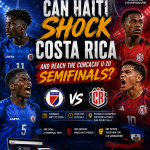
Can Haiti Shock Costa Rica and Reach the Concacaf U-20 Semifinals?

PUEBLA, Mexico — Haiti’s remarkable run through the 2026 Concacaf U-20 Championship faces its sternest test yet on Tuesday, August 4, when Les Petits Grenadiers take on Costa Rica in the tournament’s Quarterfinals at 4:00 PM. The winner not only advances toward a shot at the trophy, but also books a place at the 2027 FIFA U-20 World Cup in Azerbaijan and Uzbekistan — making this one of the most consequential 90 minutes of the tournament so far for both programs.

How Each Team Got Here

Haiti’s path has been a rollercoaster, but an effective one. After opening the tournament with a chastening 3-0 defeat to the United States, Les Grenadiers responded with genuine character: a 3-2 win over Cuba built on a dominant first-half display (Miguel Joseph and Franco Celestin combining for two goals before the break), followed by a hard-fought 2-1 win over El Salvador to close out Group A in second place behind the Americans. Six points from three matches, with the ability to win from adversity — twice.

Costa Rica’s route has been quieter, but no less effective. Los Ticos opened Group B with a 1-0 win over Guatemala courtesy of Emmanuel Hernández, then suffered their only defeat of the group stage — a 2-0 loss to host nation Mexico that included a missed opportunity from Matías Cordero and an unfortunate own goal off defender Emmanuel Brenes. Costa Rica responded well, closing group play with a comfortable 4-1 victory over Antigua and Barbuda to also finish on six points and secure second place in Group B.

The teams arrive at this quarterfinal as near-mirror images on paper: identical records, identical points totals, and each having tasted both the high of a statement win and the sting of a defeat to a tournament heavyweight.

Key Players to Watch

For Haiti, the attacking partnership has carried the team through the group stage. Franco Celestin has been directly involved in goals across multiple matches, both scoring and creating, while Miguel Joseph has shown a knack for being in the right place — his rebound finish against Cuba and a spectacular late free kick in qualifying both speak to a player capable of producing moments under pressure. Forward Nikolai Pierre, who led Haiti’s qualifying campaign with four goals, adds another attacking outlet if Haiti’s coaching staff opts to freshen up the frontline. Goalkeeper Carlos Bre will also be central to Haiti’s hopes — his shot-stopping was tested repeatedly by the United States and Cuba, and a similarly composed performance will be essential against a Costa Rican side that scored four in its last outing.

For Costa Rica, Emmanuel Hernández has been the difference-maker in tight matches, scoring the only goal against Guatemala, while the team’s ability to bounce back from the Mexico defeat with a four-goal outburst against Antigua and Barbuda suggests real attacking depth once the Ticos get in rhythm.

Tactical Breakdown and Prediction

This is a genuinely close matchup, and the numbers back that up. Both sides are unbeaten against everyone except the tournament’s most dominant team in their respective groups (Haiti lost to the U.S., Costa Rica lost to Mexico), and both found a way to regroup and finish group play strongly. That head-to-head parity — same points, similar goal-scoring bursts, one bad night against elite opposition — points to a match that could hinge on fine margins: a set piece, a moment of individual quality, or which goalkeeper has the better night.

Where Haiti may hold a slight edge is in tournament momentum and mentality. Les Grenadiers have already shown twice in this competition that they can respond to adversity — first after the U.S. defeat, and again by grinding out a result against Cuba after conceding late. That resilience matters in knockout football, where the capacity to absorb a setback and keep composure often decides tight games. Costa Rica, by contrast, has yet to be truly tested from behind in a match that mattered as much as this one will.

Where Costa Rica may hold the edge is defensive platform and squad depth on the bench — Los Ticos’ ability to switch from a shutout defensive display against Guatemala to an attacking rout of Antigua and Barbuda suggests tactical flexibility that Haiti hasn’t yet had to fully display.

Prediction: This one is close enough to go either way, but Haiti’s pattern of responding to pressure — combined with the emotional weight of a program riding historic momentum after its senior team’s long-awaited World Cup return — gives Les Grenadiers a narrow edge. Expect a tight, cagey affair that could well go to extra time, with Haiti’s attacking partnership of Celestin and Joseph likely to be the difference if the Caribbean side finds the net first. A cautious lean toward Haiti advancing, potentially 2-1 or via penalties, but Costa Rica’s balance makes this anything but a lock — and a Ticos win would surprise nobody watching this tournament closely.

What’s at Stake

Beyond the immediate thrill of a Quarterfinal, the reward for the winner is enormous: a place in the Semifinals, a step closer to the Concacaf U-20 title, and — perhaps most significantly — direct qualification for the 2027 FIFA U-20 World Cup. For Haiti, that would mean back-to-back years of history: the senior team’s return to the World Cup stage in 2026, followed by the U-20s reaching the global tournament for the first time in program history. It’s hard to overstate what a win here would mean for a soccer nation riding one of its best stretches in decades.

Kickoff is set for 4:00 PM ET on Tuesday, August 4, at Estadio Universitario BUAP in Puebla, Mexico.

Haiti Advances! Les Grenadiers Edge El Salvador 2-1 to Reach Concacaf U-20 Knockout Stage

PUEBLA, Mexico — Haiti kept its 2026 Concacaf U-20 Championship hopes firmly on track Tuesday night, holding off a furious late Cuba comeback to win 3-2 in a Group A thriller at Estadio Universitario BUAP. Les Grenadiers looked in total control for most of the match before a chaotic final ten minutes turned a comfortable lead into a nail-biter.

How It Unfolded

Haiti struck first in the 16th minute, and it came from persistence rather than a clean finish. Franco Celestin’s initial effort was parried away, but Miguel Joseph was there to pounce on the rebound, tucking it home from inside the box to put Haiti in front.

The lead grew midway through the first half when Celestin turned provider into scorer, converting from the penalty spot in the 34th minute to make it 2-0 and send Haiti into the break in firm control.

For long stretches after that, the match looked settled. But Cuba refused to fold. In the 80th minute, Yankarlos Iglesias pulled one back with a well-struck free kick, cutting the deficit to 2-1 and injecting late urgency into a match that had appeared decided.

Haiti had an answer, though. Deep into second-half stoppage time, in the 90+1′, Jacquet Da-Benz restored the two-goal cushion with a close-range finish, seemingly putting the result beyond doubt.

Cuba had other ideas. Just three minutes later, in the 90+4′, Robert Zerquera turned in a delivery from the left off an Iglesias assist to make it 3-2, setting up a frantic final push. Haiti’s defense held firm through the remaining seconds to close out the win.

Why It Matters

The victory is a big one for Haiti’s tournament prospects. After opening with a 3-0 loss to the United States, this result gets Les Grenadiers back on track in a group where every point matters for World Cup and Olympic qualification hopes. It also continues a strong individual tournament for Franco Celestin, who has now been involved in goals in back-to-back matches.

For Cuba, the late fightback offers a silver lining despite the loss — a reminder that this team can create danger even when chasing a game, but it wasn’t enough to overturn Haiti’s fast start.

What’s Next

Both teams are back in action Friday with the group finale on the line. Haiti closes out the group stage against El Salvador, while Cuba faces the United States — a match Haiti will be watching closely, since results elsewhere could directly shape where Les Grenadiers land in the final Group A standings.

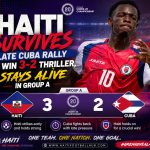
Haiti Survives Late Cuba Rally to Win 3-2 Thriller, Stays Alive in Group A

PUEBLA, Mexico — Haiti kept its 2026 Concacaf U-20 Championship hopes firmly on track Tuesday night, holding off a furious late Cuba comeback to win 3-2 in a Group A thriller at Estadio Universitario BUAP. Les Grenadiers looked in total control for most of the match before a chaotic final ten minutes turned a comfortable lead into a nail-biter.

How It Unfolded

Haiti struck first in the 16th minute, and it came from persistence rather than a clean finish. Franco Celestin’s initial effort was parried away, but Miguel Joseph was there to pounce on the rebound, tucking it home from inside the box to put Haiti in front.

The lead grew midway through the first half when Celestin turned provider into scorer, converting from the penalty spot in the 34th minute to make it 2-0 and send Haiti into the break in firm control.

For long stretches after that, the match looked settled. But Cuba refused to fold. In the 80th minute, Yankarlos Iglesias pulled one back with a well-struck free kick, cutting the deficit to 2-1 and injecting late urgency into a match that had appeared decided.

Haiti had an answer, though. Deep into second-half stoppage time, in the 90+1′, Jacquet Da-Benz restored the two-goal cushion with a close-range finish, seemingly putting the result beyond doubt.

Cuba had other ideas. Just three minutes later, in the 90+4′, Robert Zerquera turned in a delivery from the left off an Iglesias assist to make it 3-2, setting up a frantic final push. Haiti’s defense held firm through the remaining seconds to close out the win.

Why It Matters

The victory is a big one for Haiti’s tournament prospects. After opening with a 3-0 loss to the United States, this result gets Les Grenadiers back on track in a group where every point matters for World Cup and Olympic qualification hopes. It also continues a strong individual tournament for Franco Celestin, who has now been involved in goals in back-to-back matches.

For Cuba, the late fightback offers a silver lining despite the loss — a reminder that this team can create danger even when chasing a game, but it wasn’t enough to overturn Haiti’s fast start.

What’s Next

Both teams are back in action Friday with the group finale on the line. Haiti closes out the group stage against El Salvador, while Cuba faces the United States — a match Haiti will be watching closely, since results elsewhere could directly shape where Les Grenadiers land in the final Group A standings.

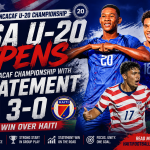
USA U-20 Opens Concacaf Championship with Statement 3-0 Win Over Haiti

PUEBLA, Mexico — The United States sent an early message to the rest of the region on Saturday night, dispatching Haiti 3-0 in the Group A opener of the 2026 Concacaf U-20 Championship at Estadio Universitario BUAP. The result extends the Americans’ perfect head-to-head record against Les Petits Grenadiers to five wins in five all-time meetings, and it puts the Stars and Stripes firmly in control of a group they’ll need to navigate en route to one of the region’s coveted spots at the 2027 FIFA U-20 World Cup.

The Story of the Match

This was billed as Haiti’s toughest test of the tournament, and it played out that way. The young Grenadiers arrived in Puebla off the back of a perfect run through Group D of qualifying — four wins from four, a staggering 16-1 goal differential, and momentum from a dramatic late comeback over host Curaçao in the previous round. But regional pedigree told on the night, as the U.S. used its size, organization, and quality in the final third to control large stretches of the match and turn a tight opening frame into a comfortable scoreline by the final whistle.

For the Americans, this was exactly the kind of statement performance expected from a program still chasing a return to the top of the region after finishing runners-up in 2024. Head coach Rob Valentino’s side leaned on its usual blend of MLS academy products and Europe-based talent to wear down a Haitian team that had shown real quality in patches but ultimately couldn’t find an answer once the U.S. found its rhythm.

Haiti, for its part, will have to regroup quickly. This tournament represents a golden opportunity for the program — a chance to reach a first-ever men’s U-20 World Cup and open a pathway toward both the 2027 Pan American Games and the 2028 Los Angeles Olympics. A shutout loss in the opener is a setback, but far from a fatal one in a group stage that still has two matches left to play.

What It Means for Group A

The result puts the United States in the driver’s seat early, needing results against El Salvador and Cuba to lock down top spot and a smooth path into the knockout rounds. For Haiti, the equation is now clearer and more urgent: with the toughest fixture on paper already out of the way, points against Cuba and El Salvador become close to essential if Les Petits Grenadiers want to keep their World Cup and Olympic qualification hopes alive.

The margin matters here too — with only the top finishers advancing out of the group, goal differential could easily come into play if the group tightens up over the next two matchdays, making Saturday’s three-goal margin a swing factor Haiti will be watching closely as the group unfolds.

What’s Next

Both teams turn around quickly. The United States is next in action against El Salvador, while Haiti will look to bounce back against Cuba — a match that now carries considerably more weight after Saturday’s result. With the group stage running through August 1, there’s still time for Haiti to complete the job, but the margin for error just got a lot smaller.

Five Things to Know About the 2026/27 Concacaf Nations League — And What It Means for Haiti

With the dust barely settled on a historic FIFA World Cup, Concacaf wasted no time turning the page: the region’s national teams now shift focus to the 2026/27 Concacaf Nations League, whose Group Stage draw was conducted Thursday night in Miami. For Haiti, fresh off a landmark first World Cup appearance in 52 years, the competition offers a fast return to meaningful matches — and a direct route toward the 2027 Gold Cup. Here are five things to know.

1. What is the Concacaf Nations League?

The Concacaf Nations League is the region’s answer to Europe’s Nations League — a structured, competitive tournament that replaced what used to be a calendar full of exhibition-style friendlies. Every one of Concacaf’s 41 member associations is placed into one of three tiers — League A, League B, or League C — based on their performance in the previous edition, with promotion and relegation between tiers determined at the end of each cycle. Now in its fifth edition, the competition has become the backbone of Concacaf’s international match calendar, giving teams of every level meaningful, competitive games rather than throwaway friendlies, while building toward the region’s biggest prize outside a World Cup cycle: the Gold Cup.

2. How Did Haiti Qualify for League A?

Haiti’s spot among Concacaf’s top 16 nations wasn’t handed to them — they earned it emphatically. In the 2024/25 edition of the competition, Haiti went a perfect six-for-six, winning every match and topping League B’s Group C, which secured their promotion into League A and, with it, qualification for the 2025 Concacaf Gold Cup. That surge came under head coach Sébastien Migné, who took charge in June 2024 and has overseen the most successful stretch in the program’s modern history — one that also included Haiti’s stunning run through World Cup qualifying, where Les Grenadiers topped their third-round group ahead of Honduras, Costa Rica, and Nicaragua to reach the 2026 FIFA World Cup for the first time since 1974. Having graduated into the region’s top flight, Haiti now enters the 2026/27 Nations League as one of 16 League A nations for the first time in the tournament’s current format.

3. What’s the Format for the 2026/27 Concacaf Nations League?

League A features 16 teams total, but only 12 of them start in the Group Stage — the four highest-ranked nations in the confederation (Mexico, the United States, Canada, and Panama) receive a direct bye straight to the Quarterfinals. The remaining 12 teams, Haiti included, are split into two Swiss-style groups of six: Group A and Group B. Each team plays four Group Stage matches (two home, two away) during the September–October 2026 FIFA match window. The top two finishers from each group then advance to the Quarterfinals in November, joining the four bye teams for a home-and-away knockout series. Winners advance to the Concacaf Nations League Finals — a semifinal, third-place match, and final — set for Los Angeles’ SoFi Stadium in March 2027. At the bottom of the standings, there’s real jeopardy too: the two lowest finishers in League A at the end of the cycle are relegated down to League B.

4. What Else Is at Stake for Haiti’s National Team?

Beyond simple bragging rights, three things hang in the balance for Haiti this cycle:

  • A pathway to the 2027 Gold Cup. Concacaf has confirmed that Nations League results will once again determine qualification for the Gold Cup, with exact criteria to be announced — meaning every group-stage point matters for Haiti’s hopes of returning to the region’s flagship tournament.
  • Protecting their hard-earned League A status. Having only just been promoted, Haiti has a target on its back. A poor campaign risks an immediate relegation back to League B, undoing the progress of the last two years.
  • Sustaining momentum from a landmark year. Haiti’s 2026 was defined by a bittersweet World Cup debut — they were eliminated after three tough losses in the “Group of Death” alongside Brazil, Morocco, and Scotland, but pushed both Scotland and Morocco to the wire and won plenty of new admirers along the way. A strong Nations League campaign is a chance to prove that historic qualification wasn’t a one-off, and to keep building toward Haiti’s next World Cup cycle.

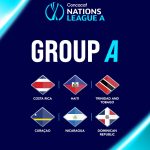
5. Group A Lineup: Who Will Haiti Face?

Thursday’s draw placed Haiti into a winnable, competitive six-team field:

TeamConfederation Ranking Pot
Costa RicaHigher-ranked League A side
HaitiMid-tier League A side
Trinidad and TobagoMid-tier League A side
CuraçaoPromoted from League B
NicaraguaMid-tier League A side
Dominican RepublicPromoted from League B

The Group Stage hasn’t kicked off yet — matches run September 21 through October 6, 2026 — so there’s no results table just yet, and every team in Group A currently sits level on zero points. But the draw sets up a fascinating race: Costa Rica arrives as the group’s most experienced side, while Curaçao and the Dominican Republic — both freshly promoted — will look to prove they belong. For Haiti, a top-two finish would send them into the Quarterfinals in November with a real shot at reaching the Finals in Los Angeles next spring.

Group B, for context, pairs Honduras, Jamaica, Guatemala, Suriname, Martinique, and El Salvador — meaning the road through Group A runs almost entirely through Central American and Caribbean rivals Haiti has faced many times before.

With kickoff still two months away, Haiti now knows exactly what stands between them and another step forward: four matches, six weeks, and a chance to turn a historic World Cup summer into sustained momentum on the road to 2027.

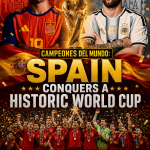
Campeones del Mundo: Spain Conquers a Historic World Cup

Sixteen years after Andrés Iniesta’s extra-time strike beat the Netherlands in Johannesburg, Spain are world champions once again. On Sunday night at MetLife Stadium in East Rutherford, New Jersey, La Roja beat defending champions Argentina 1-0 after extra time, with substitute Ferran Torres converting a Nico Williams header just moments into the second period of extra time to break a stubborn, goalless deadlock. Argentina, chasing the first back-to-back title since Brazil in 1958 and 1962, were reduced to ten men and simply couldn’t find a way through a Spanish defense that has now conceded a single goal across the entire tournament.

Congratulations, Spain. This is a team that didn’t just win a World Cup — it played the most defensively dominant tournament in the competition’s history, setting a record for clean sheets along the way, while a new generation led by 19-year-old Lamine Yamal announced itself to the world. Luis de la Fuente’s side arrived in North America as one of several favorites and leaves as the first European nation to win a World Cup on American soil, adding a second star to a shirt that had waited a decade and a half for company.

The Tournament in Review

This was the biggest World Cup ever held — 48 teams, three host nations, and 104 matches spanning the United States, Mexico, and Canada. Judged purely as a spectacle, it delivered. Judged as an piece of organization, it was far messier. Here’s how it broke down.

The Highs

A changing of the guard, and a golden generation confirmed. Yamal’s coming-out party doubled as validation for Spain’s remarkable production line, while Argentina’s Lionel Messi, at 38 and playing what was almost certainly his final World Cup, dragged his team to the final almost single-handedly — Argentina trailed at the 90-minute mark in every single one of their knockout games and still found a way through, twice via stoppage-time winners and twice in extra time, before their run finally ended against Spain.

Cinderella stories thrived. The expanded format opened the door for football’s smaller nations, and Cape Verde made the most of it, becoming one of the tournament’s most beloved surprise packages and reaching the knockout rounds in their World Cup debut. Jordan, Uzbekistan, and Curaçao also made their first appearances on the sport’s biggest stage — a genuine, tangible benefit of the 48-team expansion that FIFA had promised.

Goals, drama, and a wild third-place game. England’s 6-4 win over France in the third-place match, with Bukayo Saka scoring a hat-trick, was one of the most entertaining games of the tournament. Kylian Mbappé finished as the World Cup’s all-time leading scorer. The semifinals delivered contrasting styles — Spain’s suffocating 2-0 defensive masterclass against France, and Argentina’s grinding, dramatic 2-1 escape against England — that showed off the full range of what this tournament had to offer.

A genuine global occasion. FIFA reported well over 500 million ticket applications, and the event closed with the first-ever World Cup halftime show at the final, featuring Coldplay, Madonna, Shakira, and BTS. Whatever else can be said about the tournament’s organization, the appetite for it was undeniable.

The Lows

Officiating controversy. Refereeing and VAR decisions were a persistent storyline, most notably when Egypt filed a formal complaint after a 3-2 Round of 16 loss to Argentina, alleging a wrongly disallowed goal and a missed penalty call. It wasn’t an isolated incident — questions about consistency in VAR reviews followed the tournament from the group stage through the knockouts.

The 48-team format’s growing pains. Expansion delivered on inclusivity but exposed real structural flaws. With eight of twelve third-place group finishers advancing, several teams could — and did — reach the knockout rounds without winning a single group game, diluting the stakes of the group stage and reviving fears about collusion in final-round fixtures where two teams could calculate a mutually beneficial result in advance.

Logistics and travel. Spreading 104 matches across three enormous countries created brutal travel and jet-lag burdens for teams and fans alike, and environmental groups flagged this as among the most carbon-intensive World Cups on record given the sheer volume of cross-continental flights required.

Access and affordability. FIFA’s demand-based, variable ticket pricing pushed the cost of marquee matches sharply higher than at previous tournaments, pricing out many ordinary fans. Reports of visa and immigration-related fears also discouraged some travelling supporters from attending matches in the United States.

Heat. Extreme temperatures in several host cities forced hydration breaks and raised ongoing concerns about player welfare and match scheduling in North American summer conditions.

What FIFA Should Fix Before 2030

The 2030 World Cup — a sprawling event of its own, split primarily between Spain, Portugal, and Morocco, with commemorative centenary matches in Uruguay, Argentina, and Paraguay — will only amplify many of these same challenges unless FIFA addresses them directly:

  1. Rethink the third-place qualification pathway. Reducing the number of third-placed teams that advance, or adjusting tiebreakers further, would restore jeopardy to final group games and reduce collusion risk.
  2. Standardize and communicate VAR protocols better. Clearer, more consistent officiating standards — and faster, more transparent decision explanations — would go a long way toward restoring trust after a tournament full of contentious calls.
  3. Cap or regulate ticket pricing. A return to fixed-tier pricing, or at least tighter limits on demand-based surges, would make marquee matches accessible to more than just the highest bidders.
  4. Build smarter travel corridors. With three-to-six host nations now the norm, FIFA needs regional clustering of group-stage matches to cut down on transcontinental travel for both teams and traveling fans.
  5. Take heat and player welfare seriously. More systematic scheduling around extreme heat — earlier kickoffs, more built-in rest days between matches — should be a baseline requirement, not an in-tournament adjustment.
  6. Address visa and entry barriers early. Fans and even accredited media faced real uncertainty around entry requirements; clear, unified guidance well ahead of kickoff should be non-negotiable for a multi-nation hosting model.

Final Word

For all its off-field turbulence, the 2026 World Cup will be remembered as the tournament where Spain’s golden generation finally delivered a second star, where Lamine Yamal arrived as the face of the sport’s next era, and where Lionel Messi closed out an Argentina career for the ages with one final, heroic run. FIFA now has four years to turn a spectacular but unwieldy 48-team experiment into something more polished before the world reconvenes in 2030.

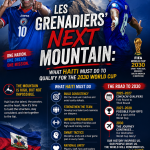
Les Grenadiers’ Next Mountain: What Haiti Must Do to Qualify for the 2030 World Cup

Haiti’s football story took a historic turn when Les Grenadiers ended a 52-year wait and qualified for the 2026 FIFA World Cup, topping Group C of CONCACAF’s Third Round ahead of Costa Rica, Honduras, and Nicaragua. Duckens Nazon topped the qualifying scoring charts with six goals, and coach Sébastien Migné led the team into its first World Cup appearance since 1974. That achievement alone reshaped what Haitian fans believe is possible.

Now the conversation turns to what comes next. A quick correction on the premise: the 2030 World Cup will not be hosted by Morocco alone — it’s a joint tournament staged primarily across Morocco, Portugal, and Spain, with three centenary matches played in Uruguay, Argentina, and Paraguay to mark 100 years since the first World Cup. All six host nations qualify automatically. Everyone else, Haiti included, has to earn a spot through the regular qualifying process — and this time, the road runs through a brand-new CONCACAF format.

The New CONCACAF Road to 2030

CONCACAF confirmed in February 2026 that it is retiring the old “Hex” system entirely. For 2030, the region will have six direct qualification berths plus a seventh available through an intercontinental playoff — up from three direct spots in previous cycles, reflecting the expanded 48-team World Cup. The new path runs in three stages:

  • Round One (Sept–Oct 2027): The 22 lowest-ranked CONCACAF nations (roughly No. 14–35 in the FIFA rankings) play home-and-away, total-goals knockout ties.
  • Round Two (late 2027–early 2028): The 11 Round One winners join the confederation’s top 13-ranked teams. Twenty-four teams split into six groups of four; the top two in each group advance.
  • Final Round (2028–2029): Twelve teams split into three groups of four. The top two finishers in each group qualify directly. The two best third-place teams meet in a home-and-away Play-In, with the winner advancing to FIFA’s Intercontinental Play-Off for a possible seventh CONCACAF berth.

Haiti’s current FIFA ranking should place them among the higher seeds entering this cycle, likely giving them a bye into Round Two rather than starting from Round One — but that has to be earned and protected between now and 2027 through Nations League results and friendlies, since seeding is ranking-based.

What Haiti Needs to Do

1. Protect and convert the 2026 breakthrough into a real program, not a moment

World Cup qualification can be a spark or a flash in the pan. The federation’s first job is turning this generation’s success into infrastructure: better contracts and continuity for Migné or his successor, a clear technical philosophy, and investment in youth pathways so the pipeline doesn’t dry up once this core group (many now in their late 20s/early 30s) ages out.

2. Lock in the diaspora pipeline

Haiti’s rise has been built substantially on dual-national players from the French and Belgian pro pyramids — the federation’s scouting network in Europe has to stay aggressive and proactive, identifying eligible talent early (ideally at youth level) before rival federations do. This is Haiti’s single biggest competitive advantage over most Caribbean rivals and it needs a full-time, well-resourced scouting operation, not ad hoc discovery.

3. Fix the home-stadium problem

Haiti has played its “home” World Cup qualifiers at neutral or foreign venues for years because of instability and infrastructure gaps at home. Re-establishing a genuine home-field advantage — even a temporary regional base like Curaçao or the Dominican Republic used consistently, ideally trending toward playing inside Haiti again when conditions allow — would meaningfully boost qualifying results. Crowd support and travel fatigue for opponents matter more in a marathon qualifying format than people often credit.

4. Win the games qualifying seeding depends on

Because Round Two and Final Round groupings are ranking-based, results in the 2026–27 Nations League and any available friendlies directly shape the difficulty of Haiti’s group draws. A higher seed means avoiding the CONCACAF heavyweights (USA, Mexico, Canada) until later rounds. Treat every meaningful match between now and September 2027 as qualifying preparation, not a throwaway friendly.

5. Build squad depth at the goalscoring and defensive-organization positions

Nazon carried an outsized share of Haiti’s qualifying goals in the last cycle. A single focal striker is a fragile plan across a longer, harder format with more games. Haiti needs a second and third scoring threat to emerge, plus continued investment in defensive shape — Haiti conceded soft goals against Honduras in the last cycle that a deeper, more organized backline could avoid.

6. Manage the physical and travel toll of an expanded format

More rounds mean more matches, more windows, and more travel across 2027–2029. Sports science, squad rotation, and injury management — areas smaller federations often under-resource — will matter more in this cycle than in the shorter Hex-based qualifying Haiti navigated last time.

The Bottom Line

Haiti doesn’t need a miracle to reach the 2030 World Cup — CONCACAF is handing out double the direct qualification spots it offered for previous cycles, and Les Grenadiers proved in the last cycle they can compete with the region’s traditional powers. The task now is turning a breakthrough into a repeatable formula: keep the diaspora pipeline flowing, stabilize the coaching setup, solve the home-venue question, and treat the next eighteen months of non-qualifying matches as seeding battles that will shape the draw. Do that, and Haiti heads into the 2027 qualifiers as a team other CONCACAF nations are trying to avoid — rather than one hoping just to survive.

🚨 BREAKING: MIGNÉ OUT AS HAITI HEAD COACH

The Haitian Football Federation has officially parted ways with national team coach Sébastien Migné, ending their collaboration by mutual agreement. 🤝

Under his leadership, Haiti made history — qualifying for the FIFA World Cup 2026, the nation’s first appearance in 52 years. 🇭🇹⚽

The FHF thanks Migné for his dedication and wishes him success in the next chapter of his career.

The search for Haiti’s next coach begins as the Federation continues its mission to grow and professionalize football at home. 🔴🔵

#Haiti #Grenadiers #FIFAWorldCup2026 #HaitiFootball #FHF #BreakingNews

What’s Behind the FHF’s Ticket Clarification

The trigger: a global ticket-resale scandal reaching small federations

The timing matters. In the weeks leading up to this note, a major controversy broke around FIFA’s ticketing system: multiple federations were found reselling tickets at inflated prices via FIFA’s own official platform, with allegations that Gianni Infantino was orchestrating this arrangement in exchange for political support, involving federations with no connection to certain matches — Saint-Marin, Cook Islands, and Albania were named as examples. Separately, academic research cited by The Telegraph accused FIFA of offloading tickets at steep discounts to illegal resale platforms in order to fill stadiums.

That backdrop is important: it created an environment where any national federation holding a World Cup ticket allocation — including Haiti’s — became a plausible target for public suspicion, whether or not there’s specific evidence against it.

Why Haiti specifically, and why now

Haiti’s qualification was an emotionally massive story — their return to the World Cup came 52 years after their only prior appearance, in 1974 — which means demand for tickets among the Haitian diaspora was enormous and prices were a sensitive issue from the start. FIFA had introduced a $60 “Tribune Basique” ticket tier specifically meant to make roughly 1,000 seats per match accessible to lower-income supporters, distributed through national federations like the FHF according to each federation’s own eligibility criteria.

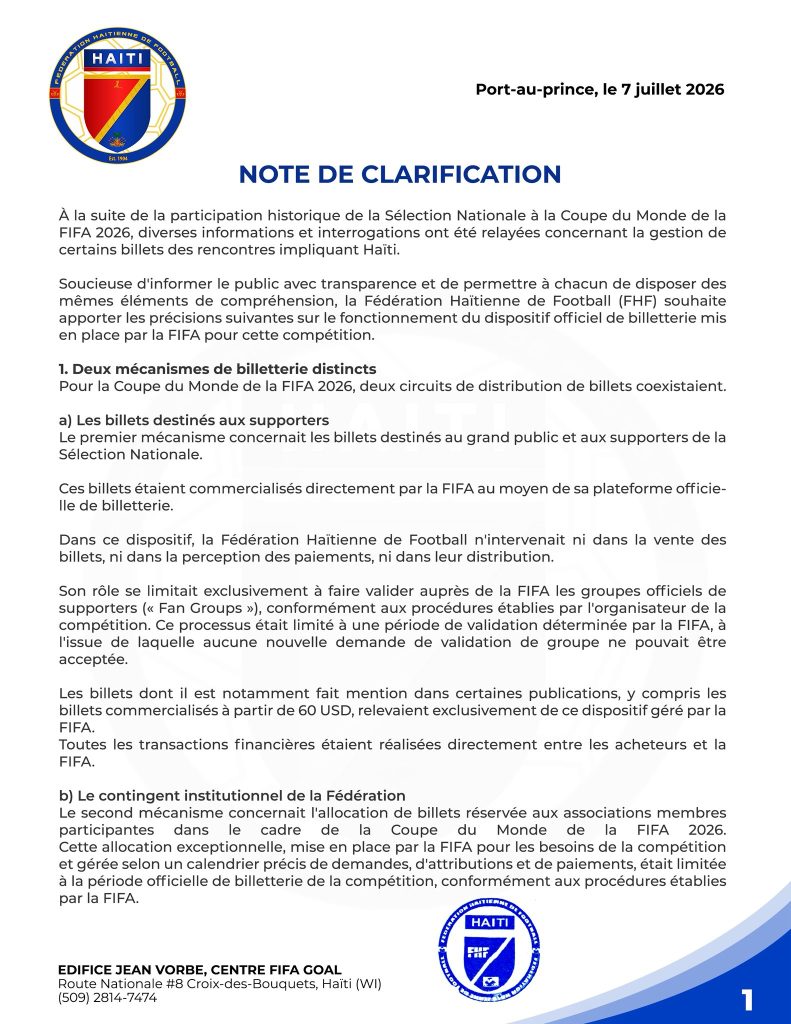
The note itself tells you what it’s responding to: it opens by acknowledging “diverses informations et interrogations” circulating about how the FHF managed certain tickets, and it specifically flags “les billets dont il est notamment fait mention dans certaines publications, y compris les billets commercialisés à partir de 60 USD.” In plain terms — someone, likely journalists or social media accounts, published claims (probably screenshots of tickets being resold above face value, or photos of institutional/VIP tickets in the hands of people who aren’t players, staff, or officials) suggesting the FHF profited from or facilitated resale of that $60 allocation, or of the separate institutional block given to federations.

What the note actually claims

Reading it as an investigator, the FHF’s defense rests on three legal/administrative distinctions:

  1. Two separate ticket pipelines. Public-facing tickets (including the $60 tier) were sold directly by FIFA to individual buyers — the FHF’s only role was validating official “Fan Groups,” with no money passing through the federation.
  2. A documented institutional allocation. A second, smaller batch was purchased by the federation from FIFA (not given for free) for players, staff, club reps, and partners — and the FHF says every step (request, invoice, payment, issuance) is logged in FIFA’s own systems.
  3. A liability firewall. Once tickets were validly distributed to individuals, the FHF says it has no legal or practical means to control what those individuals later did with them — i.e., if a player or official resold their ticket, that’s on them personally, not the institution.

The investigator’s read: plausible, but incomplete

This is a carefully lawyered statement, and there’s nothing inherently implausible about it — the two-track system it describes matches how FIFA’s ticketing genuinely works for member associations. But a few things are worth flagging:

  • It doesn’t name names. The note never identifies who published the accusations, what evidence they presented, or which specific tickets/transactions are in dispute. That makes it hard to independently verify the FHF’s rebuttal against the original claim.
  • The credibility gap. The FHF’s governance history matters here: it has been run since December 2020 by a FIFA-appointed normalization committee, put in place specifically because of a major scandal — the FHF’s longtime president, Yves Jean-Bart, was found by FIFA’s ethics committee to have raped players, including minors aged 14, 15, and 16. That history of institutional failure is precisely why any new allegation of mismanagement, even around something as comparatively minor as tickets, draws heightened scrutiny and less benefit of the doubt.
  • The “personal responsibility” disclaimer is doing a lot of work. By stating that resale after distribution is a private matter beyond its control, the FHF is pre-emptively distancing itself from any individual (a player, an official, a “partner institutionnel”) who might turn up in reporting having sold their ticket at a markup. That’s a legally sound position, but it doesn’t resolve the underlying public question of whether the allocation criteria themselves were fair or exploited by insiders.
  • The invocation of audits is reassurance, not evidence. Pointing to “des audits de gestion… réalisés périodiquement par des cabinets indépendants mandatés dans le cadre des programmes de la FIFA” tells the public a process exists — it doesn’t disclose what those audits found, or whether this specific episode will be part of one.

Bottom line

This reads less like a confession or a cover-up and more like a standard institutional damage-control document: acknowledge the noise, explain the mechanism in technical detail, deny direct institutional wrongdoing, and point to existing oversight structures — all without addressing the specific facts that prompted the public scrutiny in the first place. Given the FHF’s track record and the fact that this scandal is unfolding inside a much larger FIFA-wide ticket-resale controversy, the more interesting question an investigator would chase next isn’t whether the rules the FHF describes exist — it’s who inside or connected to the federation actually received institutional tickets, and whether any of those specific individuals are the ones who show up in the resale listings that apparently prompted this note.

Can Sports Drive Economic Development in Haiti?

An Analytical Report

Prepared July 2026 | By an Expert in Haitian Sports and Development

Executive Summary

Haiti qualified for the 2026 FIFA World Cup — its first since 1974 — and played on the world’s biggest sporting stage against Scotland, Brazil, and Morocco this summer. It did so while gang violence was killing more than 5,500 people a year, while real GDP was contracting for a seventh consecutive year, and while roughly 49% of the population lived on less than $3 per day. The gap between those two realities is not a paradox. It is the central analytical problem this report addresses.

The short answer to the question “can sports drive economic development in Haiti?” is: not alone, not automatically, and not without radical governance reform — but yes, under specific conditions and through specific channels, sports can make a measurable and meaningful contribution to economic development in Haiti. Those conditions are more demanding than sports advocates typically acknowledge, and the channels are narrower than policy optimists prefer to advertise. This report maps both with honesty.

Part I: The Starting Point — Haiti’s Economic Reality

Before asking what sports can do, we must be clear about what Haiti is dealing with. The numbers are stark.

Haiti remains the poorest country in Latin America and the Caribbean, and among the poorest in the world. Its economy has contracted for seven consecutive years as of 2025, with real GDP falling 2.7% in 2025 alone, following a 4.2% decline in fiscal year 2024. Inflation averaged 28.3% in 2025, driven primarily by food and housing costs that hit the poorest households hardest. Government revenue has collapsed to just 4.8% of GDP — one of the lowest tax-collection rates in the hemisphere, and a fraction of the roughly 21.5% average for other Latin American and Caribbean countries. The country’s HDI score of 0.554 places it 166th out of 193 countries globally.

The structural driver of economic activity in this environment is not investment, not exports, and not government spending. It is remittances. Haitian diaspora transfers totaled approximately $4.2 billion in 2024 — representing roughly 16 to 21% of GDP depending on the measurement base — a figure four times greater than the country’s exports and nearly 100 times larger than foreign direct investment. These remittances are the largest single source of foreign exchange Haiti has, and they are also overwhelmingly spent on immediate consumption: food, school fees, and healthcare rather than productive investment.

Into this environment, the question of sports-as-economic-development is not a frivolous one. But it has to be asked honestly, against a backdrop where gangs control large parts of the capital, more than 1.4 million people are internally displaced, 900 schools remain closed, and the port receiving 80% of international trade is periodically blockaded by armed groups. Any discussion of sports driving development that doesn’t center this security reality is not serious analysis.

Part II: What Sports Actually Does in Haiti Today

2.1 Football as the Dominant Sports Economy

Football is not merely Haiti’s most popular sport — it is, by a wide margin, the country’s only sports sector with any meaningful economic footprint. The Ligue Haïtienne, the country’s top domestic league, operates in genuinely difficult conditions: low gate revenues, minimal broadcast rights income, no significant domestic title sponsorship, and a persistent talent-drain as the best players emigrate to professional leagues in Europe and North America. The economic return to Haiti from its own top football league is modest at best.

What has generated real money is international football performance — and the 2026 World Cup qualification is the clearest example yet of how that works. FIFA’s prize structure guarantees every group-stage participant at least $12.5 million: $2.5 million in preparation fees plus $10 million for participation. For a country whose government collects tax revenue equal to roughly 4.8% of a roughly $20 billion GDP — approximately $960 million — a single World Cup appearance represents a windfall equivalent to more than 1% of national tax revenues, paid to the federation rather than to the state, but representing genuine hard-currency inflow. The Haitian government’s own $4 million allocation ($2M qualification bonus + $2M preparation support) layered on top of FIFA’s prize money shows how World Cup qualification functions as a fiscal event, not just a sporting one.

However — and this caveat is essential — that money flows to the Fédération Haïtienne de Football, not to a general economic multiplier. Whether it circulates into the broader economy depends entirely on how the federation spends it, and Haiti’s federation governance history (explored in the prior report on FHF financing) suggests that historical precedent is not encouraging.

2.2 The Diaspora Dimension: Sports as a Remittance Catalyst

This is perhaps the most underappreciated economic channel in the Haiti sports equation, and it is the one where the 2026 World Cup has demonstrated real, visible impact.

Of Haiti’s 26-player World Cup squad, only one — Woodensky Pierre — plays for a Haitian domestic club. Ten were born in Haiti; twelve were born in France of Haitian parents; others were born in Canada, Switzerland, and the United States. The national team is, in economic terms, a diaspora institution. Its players earn professional salaries in French Ligue 1, Turkish Super League, Belgian Pro League, and MLS clubs — wealth accumulated abroad and, in many cases, partially directed back to Haiti.

When diaspora communities in Boston, New York, Miami, Montreal, and Paris gather to watch Haiti play, the economic activity generated — restaurant spending, merchandise purchases, media subscriptions, community event revenue — circulates primarily in host countries, not in Haiti itself. But the pride and identity reinforcement that comes from a World Cup appearance has a measurable if difficult-to-quantify effect on diaspora engagement with Haiti, including charitable giving, investment interest, and remittance motivation. A study of remittances in post-earthquake Haiti showed that diaspora transfers remained “strong and relatively steady,” even as economic conditions worsened — a resilience that has cultural and emotional drivers, not merely financial ones. Sports success feeds that emotional connection.

The deeper economic potential here is converting the diaspora’s emotional investment in Haitian sports from passive consumption (watching games, buying jerseys) into active investment (funding sports infrastructure, training academies, sports tourism development). That conversion has happened in other Caribbean nations and is theoretically available to Haiti; it requires intentional diaspora investment policy that Haiti has historically lacked, with no formal diaspora engagement framework.

2.3 Sports for Development: The Proven Model

The most rigorously documented case of sports generating economic outcomes in Haiti is not professional football at all. It is the A Ganar (“To Win”) program, backed by a $3.6 million grant from the Inter-American Development Bank’s Multilateral Investment Fund and run in Haiti by Robert “Boby” Duval’s Fondation L’Athlétique d’Haïti.

The programme uses sports not as a commercial enterprise but as a pedagogical tool: participants spend an initial phase developing communication, teamwork, and problem-solving skills through athletic exercises, before transitioning to technical training in trades such as construction, garment manufacturing, and car mechanics, and ultimately to internships in businesses, NGOs, and local government. An external evaluation of the pilot programme across its first 6,000 participants in 10 countries found that 78% of those who enrolled graduated, and of those completing the full 240 hours of training, 68% found jobs, went back to school, or started their own businesses. Those are outcomes that many conventional vocational training programmes would envy.

Duval’s description of A Ganar as “the missing link” in helping young Haitians transition into the workplace captures exactly why the sports-for-development model matters in a context where formal labor markets barely function: it addresses the psychosocial gap — self-esteem, discipline, resilience — that disadvantaged Haitian youth face, not just the technical skills gap. In a country where approximately 90% of workers are informally employed in precarious jobs and where youth unemployment and gang recruitment are tightly correlated, that psychosocial function has economic value that is real but notoriously hard to capture in GDP statistics.

2.4 The Informal Sports Economy

Below the level of formal programmes and international competition sits an informal sports economy that is economically invisible but socially significant. Street football, local basketball courts, neighborhood tournaments, and community athletic events in Haiti generate informal economic activity — small vendors, equipment rentals, informal coaching, local transport — that provides livelihoods to thousands of Haitians in communities where formal employment is essentially absent. This informal layer is not trivial; it is where most Haitian sport actually happens, and it is the layer most vulnerable to gang violence, which closes courts and pitches with the same lethal efficiency it applies to schools and markets.

Part III: The Five Channels Through Which Sports Can Drive Development

Having mapped what sports currently does in Haiti, we can now analyze the five distinct channels through which a more intentional sports development strategy could generate economic returns.

Channel 1: Human Capital Formation (Highest Potential)

The A Ganar evidence demonstrates that sports-for-development programmes can improve labor market outcomes for disadvantaged youth. Scaling that model nationally would require institutional investment — trained coaches who are also certified vocational instructors, physical infrastructure beyond Port-au-Prince, and coordination with private sector employers willing to absorb interns and graduates. The cost-benefit case is strong: the IDB’s own evaluation suggests the cost per successful outcome is competitive with conventional vocational programs, and the behavioral co-benefits (reduced gang recruitment, improved school retention) add social returns that aren’t captured in employment statistics alone.

Haiti’s young population — over 60% under age 25 — is the structural precondition for this channel to matter at scale. The country’s demographic dividend can only be realized if young people have skills and pathways to formal employment. Sports-for-development is not a substitute for education reform, but it can serve as a bridge for the estimated hundreds of thousands of Haitian youth currently outside both school and the formal economy.

Channel 2: Diaspora Remittance Mobilization (High Potential, Underutilized)

With $4.2 billion in diaspora remittances flowing into Haiti annually — currently going 80%+ to immediate consumption — the strategic question is whether sports success can shift even a fraction of that toward productive investment in sports infrastructure, academies, and related services.

The Dominican Republic, Haiti’s neighbor, has done exactly this in baseball: MLB academies in the Dominican Republic represent hundreds of millions of dollars of foreign investment in training facilities, nutrition, coaching, and youth development, with multiplier effects on local employment and the construction sector. Baseball academies now dot the DR’s landscape, creating a pipeline of talent that generates transfer fees back to Dominican clubs and income opportunities for coaches, trainers, physiotherapists, nutritionists, and support staff. Haiti has the football talent to replicate this model — the 2026 World Cup squad itself is proof — but it lacks the domestic infrastructure to capture the value. Twelve of the 26 players in Haiti’s squad were developed through the French football system, not Haiti’s. That is talent Haiti produced biologically but could not develop institutionally. Each elite player developed in France rather than Haiti represents a potential transfer fee — often worth millions of euros — that would have flowed to a Haitian club if the infrastructure had existed to develop them locally.

Channel 3: Sports Tourism (Medium Potential, Long Time Horizon)

Before gang violence made large parts of Port-au-Prince inaccessible, Haiti had meaningful tourism assets: beaches, mountains, cultural heritage, and the energy of Caribbean sports culture. Several northern cities — Cap-Haïtien, Jacmel — retain potential as regional sports tourism destinations once security conditions permit.

Sports tourism in the Caribbean has proven to be a real economic driver for smaller nations: the Caribbean Premier League (CPL) in cricket, CONCACAF tournaments hosted in multiple island nations, and regional athletics meets all generate hotel occupancy, restaurant revenue, transport spending, and visibility benefits that outlast the events themselves. Haiti is a founding member of CONCACAF, has a legitimate football culture that predates that of most Caribbean neighbors, and could plausibly develop a regional role as a football training hub or tournament host — but not until security conditions allow international visitors to move freely, and not without sustained investment in hospitality and transport infrastructure that currently does not exist.

The 2026 World Cup demonstrated the inversion of this dynamic: U.S. travel bans and economic exclusion meant that Haitian fans couldn’t even attend their own team’s matches. At $2,100 per ticket to the Scotland game alone, Haitian-Americans in Boston couldn’t afford to go. The World Cup generated zero direct tourism receipts for Haiti while generating enormous pride and soft-power visibility — the symbolic benefit of international sports without any of the economic return normally associated with fan travel.

Channel 4: Athlete Transfer Fees and Salary Remittances (Real but Currently Leaking)

Professional athletes from Haiti are a financial asset that Haiti is currently not capturing. When a player developed in the French academy system goes to a Belgian club for €3 million, that transfer fee goes to the French club, not to any Haitian institution. When that same player earns a professional salary in Europe and sends portions home, those remittances arrive as consumer funds, not as organized investment.

Building domestic academies that hold FIFA registration rights to youth players would, over time, allow Haitian clubs to negotiate transfer fee shares when players leave for professional leagues abroad. FIFA’s solidarity mechanism already requires buying clubs to pay 5% of transfer fees to clubs involved in a player’s training between ages 12 and 23 — but that money flows to the clubs in the training chain, not to clubs in the player’s home country if those clubs weren’t part of the development. A domestic academy infrastructure that registers and tracks players would plug that leak.

Channel 5: Brand and Soft Power (Significant but Indirect)

Haiti’s 2026 World Cup appearance generated global media coverage that no tourism marketing budget could have purchased. The team was covered by The Conversation as “more than an underdog tale,” framed as a story of global migration, diaspora identity, and post-colonial resilience. Al Jazeera, Bloomberg, and international outlets from France to Latin America covered Haiti’s qualification extensively. That visibility has real but diffuse economic implications: it shapes how investors, development organizations, and potential partners perceive Haiti, and it reinforces diaspora pride in ways that can support remittance and investment motivation.

The challenge is that soft power generated by football visibility cannot be converted to economic activity in a country where gang violence prevents investors from operating, where the port is periodically blockaded, and where infrastructure for converting tourist interest into tourist arrivals doesn’t exist. Soft power without enabling conditions is a banner without a building.

Part IV: The Structural Barriers That Sports Cannot Overcome Alone

Honest analysis requires equal space for what sports cannot do.

Security is the binding constraint. No sports economy — formal or informal — can grow sustainably in conditions where gang violence kills thousands annually, displaces 1.4 million people, and shuts down schools, ports, and markets. The economic value of a youth sports programme in Cité Soleil is zero if the pitch is controlled by an armed gang or if the children who would attend are displaced. Sports development and security are not parallel tracks; security is the prerequisite.

Governance determines where money goes. The FHF’s own history demonstrates that international funding flows — FIFA Forward, government subsidies, World Cup prize money — can disappear into an institutional black hole without transparent governance. The conditions that allowed the Centre Technique National to receive an estimated $1 million per year from FIFA while housing children in filth are not unique to football; they characterize much of Haiti’s public institutional environment. Without independent financial accountability and governance reform, more sports money will not produce more sports outcomes.

Infrastructure gaps are acute. Haiti has one major football stadium (Stade Sylvio Cator, recently rehabilitated), minimal functioning sports facilities outside Port-au-Prince, and no sports medicine infrastructure to speak of. The IDB’s Medium-Term Recovery and Development Plan for 2025–2030 focuses on economic poles in the Great North, which could include sports infrastructure investment — but the priority sequencing of a country where nearly half the population doesn’t have enough to eat makes sports facilities a difficult political sell against hospitals, schools, and water systems.

The Dutch Disease risk. Haiti’s remittance dependence already creates a Dutch Disease-type problem: high remittance inflows appreciate the real exchange rate, making Haitian exports less competitive and suppressing exactly the tradable sectors — agriculture, manufacturing, tourism — that could create the most jobs and improve productivity. Sports-generated hard currency inflows (World Cup prize money, transfer fees, diaspora investment) would add to this dynamic if not managed deliberately. The lesson from the remittance literature is that foreign currency inflows, however welcome, can crowd out domestic productive capacity if they’re not channeled into investment.

Part V: What a Sports-for-Development Strategy Would Actually Look Like

Given the above, what would a serious, evidence-based sports development strategy for Haiti look like? Five specific, actionable components:

1. Federated Youth Academy Network. Haiti needs 5 to 10 officially registered youth football academies outside Port-au-Prince — in Cap-Haïtien, Gonaïves, Les Cayes, Jacmel — that hold FIFA player registration rights and participate in CONCACAF’s training compensation and solidarity mechanisms. This converts the talent diaspora from a pure export to a revenue-generating pipeline. Funding could combine FIFA Forward (which explicitly supports such infrastructure), IDB grants, and diaspora investment vehicles modeled on what the Dominican Republic has done in baseball.

2. Scale A Ganar Nationally. The IDB’s A Ganar model has proven outcomes at a grant cost of $3.6 million for its Haitian pilot. A national rollout covering Haiti’s 10 departments would require an estimated $30–50 million over a five-year cycle — a fraction of what FIFA Forward, IDB, and the World Bank are already committing to Haiti’s Medium-Term Recovery Plan. Embedding sports-for-development within the existing education and vocational training architecture, with private-sector employer partnerships for the internship phase, would maximize cost-effectiveness.

3. Diaspora Sports Investment Fund. A structured investment vehicle — potentially managed through the Haitian government’s existing diaspora engagement portal KODYADEV, with independent fiduciary oversight — could channel diaspora capital into sports infrastructure bonds or equity stakes in licensed academies. The model exists in other Caribbean jurisdictions; Haiti’s barrier is not diaspora willingness to invest but the absence of trustworthy institutional vehicles to invest through.

4. Regional Sports Tourism Corridor, Cap-Haïtien as Anchor. Cap-Haïtien, Haiti’s second city, has relative security advantages compared to Port-au-Prince, existing proximity to the Citadelle Laferrière (a UNESCO World Heritage site), and coast access for aquatic sports. A pilot regional sports tourism program — anchored in training camps for Caribbean national teams and diaspora sports tourism (Haitian-American football leagues, youth tournaments) — could be developed with IDB support as part of the northern development pole already identified in the 2025–2030 recovery plan.

5. FIFA Forward Accountability Reforms. Haiti’s experience under the normalisation committee — where FIFA has essentially merged its funding and oversight functions into a single administrative unit — provides a unique window to rebuild financial reporting standards from scratch. The normalisation committee’s mandate should not be completed until an independent annual audit of FIFA Forward fund deployment is institutionalized, published, and linked to disbursement in subsequent years. Making this accountability mechanism permanent before returning governance to an elected federal council is the single most important governance reform available, because all the other strategies above require trusting that money sent to football institutions in Haiti will be spent on football outcomes.

Part VI: The Verdict — Conditions for a “Yes”

Can sports drive economic development in Haiti? Yes, under five conditions that must be present simultaneously:

ConditionCurrent Status
1. Basic security for sports infrastructure to functionNot met — gang violence remains the binding constraint
2. Transparent governance of sports institutionsPartially met — normalisation committee improves oversight but is temporary
3. Diaspora investment mechanismsNot met — no structured diaspora sports investment vehicle exists
4. Integration with national development plansEmerging — IDB 2025–2030 plan creates opening but doesn’t explicitly include sports
5. Scale and consistency of sports-for-development programmesPartially met — A Ganar proves the model; national scale remains unreached

The 2026 World Cup has done something real: it has given Haiti a moment of national pride at a moment of extraordinary suffering, demonstrated the quality of diaspora-developed Haitian talent, generated more than $12.5 million in hard currency for the federation, and put Haitian football on international television screens for the first time in 52 years. That is not nothing.

But the deeper question — whether that moment converts into lasting economic development — will be answered not on the pitch in Philadelphia or Atlanta. It will be answered in the accounting offices of the FHF, in the policy rooms of the IDB and the Haitian government, in the diaspora communities of Boston and Miami deciding whether to invest or just watch, and ultimately in the security environment that determines whether Haiti’s young people can play football at all.

Sports, at its best in Haiti, is what Robert Duval called it: the missing link. Not the engine. Not the solution. But the missing link — between excluded youth and economic participation, between diaspora emotion and diaspora investment, between international visibility and national pride. In a country where institutional trust is at historic lows and where almost every other development model has been tried and failed, that missing-link function is genuinely valuable. The task is to build the chain around it.


Data Notes and Sources

Macroeconomic data: World Bank Haiti Country Overview (2025/2026); U.S. State Department Investment Climate Statement for Haiti (September 2025); Focus Economics Haiti profile; BTI 2026 Haiti Country Report.

Remittances data: Haitian Institute of Statistics and Information (IHSI); World Bank; Documented NY (March 2026); Inter-American Dialogue analysis (December 2022); ECLAC/UNDP diaspora data.

Sports-for-development evidence: Inter-American Development Bank (IDB) — A Ganar programme evaluation and Haiti reporting; Haitian Sports Foundation programme data; IJSSER sports-economy review (2025).

World Cup 2026: The Conversation (June 2026); Al Jazeera (May 2026); Bloomberg (June 2026); Outlook India (June 2026); Britannica Money economics of World Cup; sportanddev.org (June 2026); Wikipedia 2026 World Cup controversies.

Haiti football/FHF: Wikipedia (Haiti national football team, Haitian Football Federation); Grokipedia; Canada-Haiti Information Project.

Development planning: IDB Medium-Term Recovery and Development Plan 2025–2030 announcement (April 2025); World Bank Haiti strategy 2025–2029 (March 2025).