



The trigger: a global ticket-resale scandal reaching small federations
The timing matters. In the weeks leading up to this note, a major controversy broke around FIFA’s ticketing system: multiple federations were found reselling tickets at inflated prices via FIFA’s own official platform, with allegations that Gianni Infantino was orchestrating this arrangement in exchange for political support, involving federations with no connection to certain matches — Saint-Marin, Cook Islands, and Albania were named as examples. Separately, academic research cited by The Telegraph accused FIFA of offloading tickets at steep discounts to illegal resale platforms in order to fill stadiums.
That backdrop is important: it created an environment where any national federation holding a World Cup ticket allocation — including Haiti’s — became a plausible target for public suspicion, whether or not there’s specific evidence against it.
Why Haiti specifically, and why now
Haiti’s qualification was an emotionally massive story — their return to the World Cup came 52 years after their only prior appearance, in 1974 — which means demand for tickets among the Haitian diaspora was enormous and prices were a sensitive issue from the start. FIFA had introduced a $60 “Tribune Basique” ticket tier specifically meant to make roughly 1,000 seats per match accessible to lower-income supporters, distributed through national federations like the FHF according to each federation’s own eligibility criteria.
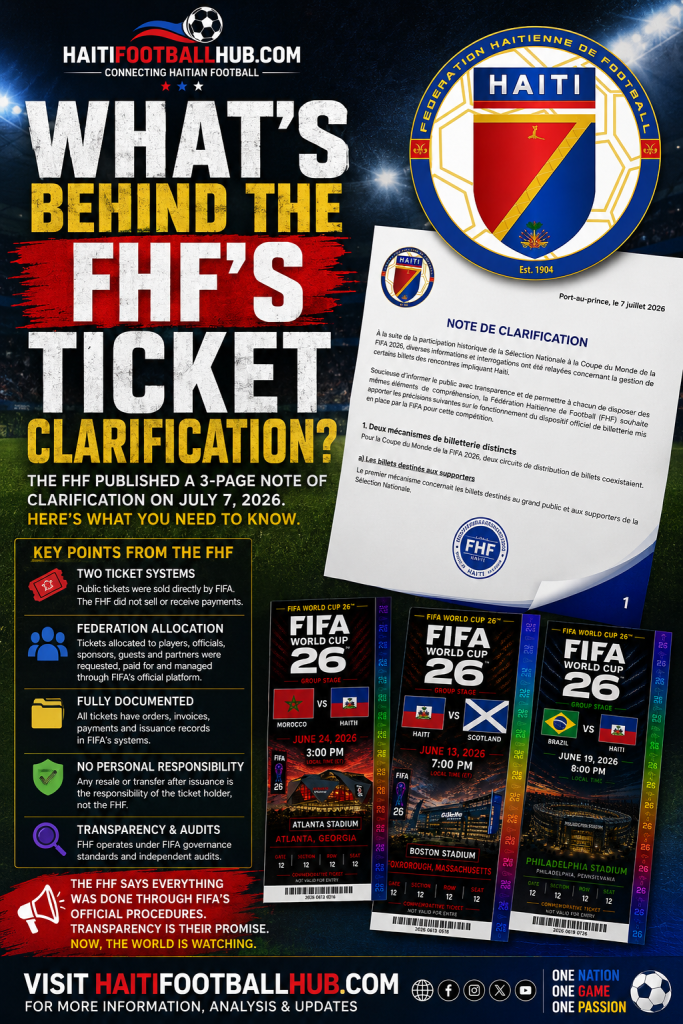
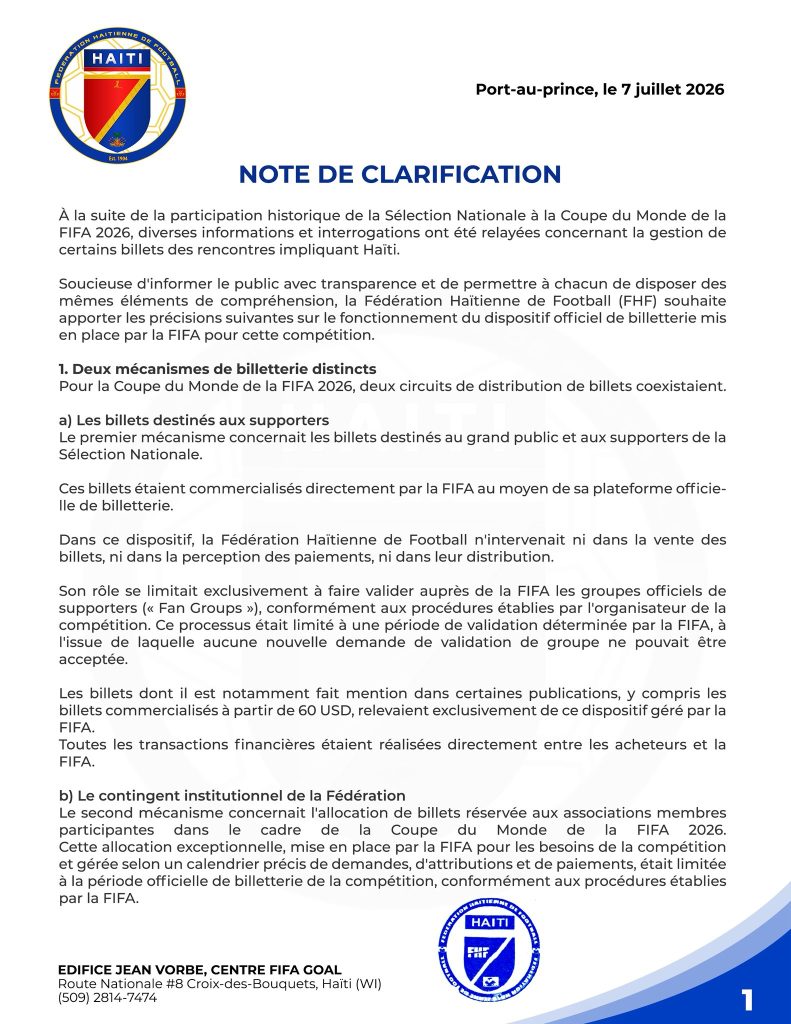
The note itself tells you what it’s responding to: it opens by acknowledging “diverses informations et interrogations” circulating about how the FHF managed certain tickets, and it specifically flags “les billets dont il est notamment fait mention dans certaines publications, y compris les billets commercialisés à partir de 60 USD.” In plain terms — someone, likely journalists or social media accounts, published claims (probably screenshots of tickets being resold above face value, or photos of institutional/VIP tickets in the hands of people who aren’t players, staff, or officials) suggesting the FHF profited from or facilitated resale of that $60 allocation, or of the separate institutional block given to federations.
What the note actually claims
Reading it as an investigator, the FHF’s defense rests on three legal/administrative distinctions:
- Two separate ticket pipelines. Public-facing tickets (including the $60 tier) were sold directly by FIFA to individual buyers — the FHF’s only role was validating official “Fan Groups,” with no money passing through the federation.
- A documented institutional allocation. A second, smaller batch was purchased by the federation from FIFA (not given for free) for players, staff, club reps, and partners — and the FHF says every step (request, invoice, payment, issuance) is logged in FIFA’s own systems.
- A liability firewall. Once tickets were validly distributed to individuals, the FHF says it has no legal or practical means to control what those individuals later did with them — i.e., if a player or official resold their ticket, that’s on them personally, not the institution.
The investigator’s read: plausible, but incomplete
This is a carefully lawyered statement, and there’s nothing inherently implausible about it — the two-track system it describes matches how FIFA’s ticketing genuinely works for member associations. But a few things are worth flagging:
- It doesn’t name names. The note never identifies who published the accusations, what evidence they presented, or which specific tickets/transactions are in dispute. That makes it hard to independently verify the FHF’s rebuttal against the original claim.
- The credibility gap. The FHF’s governance history matters here: it has been run since December 2020 by a FIFA-appointed normalization committee, put in place specifically because of a major scandal — the FHF’s longtime president, Yves Jean-Bart, was found by FIFA’s ethics committee to have raped players, including minors aged 14, 15, and 16. That history of institutional failure is precisely why any new allegation of mismanagement, even around something as comparatively minor as tickets, draws heightened scrutiny and less benefit of the doubt.
- The “personal responsibility” disclaimer is doing a lot of work. By stating that resale after distribution is a private matter beyond its control, the FHF is pre-emptively distancing itself from any individual (a player, an official, a “partner institutionnel”) who might turn up in reporting having sold their ticket at a markup. That’s a legally sound position, but it doesn’t resolve the underlying public question of whether the allocation criteria themselves were fair or exploited by insiders.
- The invocation of audits is reassurance, not evidence. Pointing to “des audits de gestion… réalisés périodiquement par des cabinets indépendants mandatés dans le cadre des programmes de la FIFA” tells the public a process exists — it doesn’t disclose what those audits found, or whether this specific episode will be part of one.
Bottom line
This reads less like a confession or a cover-up and more like a standard institutional damage-control document: acknowledge the noise, explain the mechanism in technical detail, deny direct institutional wrongdoing, and point to existing oversight structures — all without addressing the specific facts that prompted the public scrutiny in the first place. Given the FHF’s track record and the fact that this scandal is unfolding inside a much larger FIFA-wide ticket-resale controversy, the more interesting question an investigator would chase next isn’t whether the rules the FHF describes exist — it’s who inside or connected to the federation actually received institutional tickets, and whether any of those specific individuals are the ones who show up in the resale listings that apparently prompted this note.


