Category: Blog

Follow the Ball: How Haiti’s Football Federation Actually Pays Its Bills

An investigative look at the funding architecture behind the Fédération Haïtienne de Football, and where the money goes once it lands in Port-au-Prince.


The Headline Fact That Frames Everything

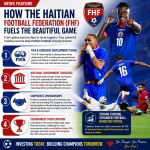
Haiti just qualified for its second-ever FIFA World Cup — its first since 1974 — and is currently competing at the 2026 tournament across the United States, Mexico, and Canada, having opened with defeats to Scotland and Brazil. That qualification is not just a sporting story. It is a financial event. World Cup qualification converts the FHF, almost overnight, from a federation surviving on modest annual grants into the recipient of a multimillion-dollar windfall — and it does so for a federation that has spent the last five years under direct FIFA receivership, following one of the worst institutional scandals in CONCACAF history.

To understand how the FHF finances itself, you have to hold two facts in tension at once: the funding mechanisms are fairly standard across small football nations (FIFA, CONCACAF, government, sponsorship, competition revenue), but the governance environment in which that money has been allocated is anything but standard. Haiti is the case study other federations get shown when administrators discuss what can go wrong.

1. FIFA Forward: The Backbone Grant

FIFA Forward is not charity in the traditional sense — it’s closer to a development-bank facility that every one of FIFA’s 211 member associations is entitled to draw on, scaled to a common formula rather than to football quality or market size.

How the money is sized. Under FIFA Forward 3.0, launched in January 2023, each member association receives approximately $8 million over a four-year cycle, a sevenfold increase compared to pre-2016 funding levels, following a 29% increase President Infantino announced at the 2022 FIFA Congress. That places the FHF’s baseline FIFA grant at roughly $2 million per year, before any World Cup-specific payments are added.

Where the global money has actually gone. FIFA’s own accounting of the programme shows the bulk of it is infrastructure and operating cost, not glamour spending: around 80% of FIFA Forward investment goes directly to member associations, with over $2.24 billion committed to projects building or modernising football infrastructure, developing domestic competitions, and covering running costs related to administration and governance. For a federation like Haiti’s, that translates concretely into facility upkeep, referee and coaching education, administrative salaries, and domestic league support — the unglamorous plumbing of a federation, not marquee signings or stadium-naming spectacle.

The compliance strings attached. Forward funding is conditional, and the conditions matter enormously for a federation with Haiti’s governance history. Since Forward 2.0’s rollout, associations must ensure principles of anti-discrimination, diversity, accessibility, and human rights are protected in funded projects, and must take measures to safeguard children and minors from potential abuse within football. Every dollar the FHF draws down is tied to FIFA’s ability to certify that the federation is meeting those safeguarding benchmarks — a requirement that, as the next section shows, is not abstract in Haiti’s case.

2. CONCACAF: The Regional Layer (“One Concacaf”)

Below FIFA sits CONCACAF, which runs its own parallel funding pipeline known as the One Concacaf Program — direct cash and in-kind support layered on top of (not instead of) FIFA Forward.

CONCACAF has been explicit that this funding stream now comes with real fiduciary expectations. As member associations continue to receive funding from CONCACAF, FIFA, and other sources — including sponsorships, broadcast opportunities, and matchday revenues — strong financial planning has become increasingly important to meeting growing fiduciary and stewardship responsibilities. In 2026, CONCACAF ran financial-planning workshops specifically built around this: member associations registered delegates who first completed a Finance Fundamentals course through the Concacaf Academy before an in-person workshop in Miami covering budgeting, financial planning, and the One Concacaf Program, including bilateral sessions tailored to each association’s specific needs.

That CONCACAF felt it necessary to put member federations through remedial budgeting training is itself a data point. It tells you the confederation does not assume its member associations — Haiti very much included — have mature internal financial controls by default; it is actively building that capacity from the outside.

CONCACAF’s own funding capacity has grown alongside its commercial business. As far back as 2018, the confederation increased its One Concacaf Funding Program by more than 35% for that year’s edition, as part of its commitment to invest directly in member associations as enablers of the game’s success. Combined with FIFA Forward, this means Haiti’s combined annual baseline support from FIFA and CONCACAF — before government money, sponsorship, or competition revenue — likely sits somewhere in the $2.5–3.5 million range in a typical non-World-Cup year, though the FHF does not publish a fully itemized account that would let an outside observer confirm an exact figure.

3. National Government Subsidies: Episodic, Political, and Headline-Driven

This is the most volatile and most politically charged of the FHF’s funding streams — and the one that has produced the clearest documentary trail in 2026.

Haiti’s government does not fund football through a standing annual line item in the way some larger federations receive guaranteed state subsidies. Instead, funding tends to arrive in discrete, occasiondriven disbursements, usually timed to a qualification milestone or a tournament. The clearest recent example:

Haiti’s government allocated 528 million gourdes — over $4 million — to the FHF, split between a World Cup qualification bonus and preparation for the 2026 tournament. Half the funding, $2 million, was awarded to the national team as a prize for qualifying for the World Cup, while the remaining $2 million supported training and logistical preparations.

The institutional split here is itself revealing about how Haitian state finance for football actually works: the Prime Minister’s Office funded the qualification bonus, while the Ministry of Youth, Sports and Civic Actions (MJSAC) financed the preparation effort — with officials presenting both checks at a ceremony in Port-au-Prince in April. In other words, there is no single government “sports budget” line writing this check — it is the executive branch (Prime Minister’s Office) covering the prize component, and the sports ministry covering the operational component, as two separate political acts with two separate ceremonial moments.

The framing from officials at that ceremony also captures how explicitly political this category of funding is treated, distinct from FIFA/CONCACAF money, which arrives with technical conditions attached rather than speeches. FHF President Monique André called it not just a check, but “a message of trust, companionship — a message of hope and above all a symbol of a nation that knows its children and still believes in itself,” while the Prime Minister framed continued support for the federation as a civic duty: “It is our responsibility as leaders to keep hope alive and set an example for the country’s future… That is why we are supporting what remains one of Haiti’s greatest sources of pride — Haitian football.”

There is also a longer history of proposed but unrealized state investment that’s worth flagging, because it shows the gap between announced and actual government funding. During the Michel Martelly administration (2011–2016), there was discussion of building a new stadium using funds from the Petrocaribe Fund, but no action was ultimately taken. That pattern — high-profile pledges that don’t convert into disbursed funds — appears repeatedly in Haitian sports-government relations and is a caution against treating any single announced figure as guaranteed cash in hand until it’s actually been transferred.

A historical wrinkle compounds the picture further: in the aftermath of the 2010 earthquake, government and international donor money for football infrastructure became entangled in graft allegations reaching back decades. Duvalier-era investment in Haitian football facilities had allegedly been financed in part by diverted U.S. humanitarian aid — a precedent that still colors how skeptically outside observers read announcements of “government support for football” in Haiti even today.

4. Corporate Sponsorship: Thin, Concentrated, and Telecom-Heavy

This is the weakest and least diversified of the FHF’s five revenue streams, and the one with the least public documentation. Unlike federations in wealthier CONCACAF markets — Mexico or the United States, where broadcast and shirt-sponsorship deals can run into tens of millions annually — Haiti’s corporate sponsorship base is narrow, historically anchored by telecom money, and supplemented by kit-supplier contracts rather than a deep bench of competing brand partners.

The clearest documented commercial deal is the federation’s kit manufacturing agreement: in 2013, the FHF signed a five-year, $1 million contract with Colombian manufacturer Saeta to supply national team kits. That figure — roughly $200,000 per year for jersey rights — gives a useful sense of scale for what “corporate sponsorship” actually means in dollar terms for a federation at Haiti’s level: modest, multi-year, product-and-cash-in-kind deals rather than the nine-figure apparel megadeals seen at larger federations.

Beyond the kit deal, Haiti’s telecommunications sector has historically been the most visible corporate backer of the federation, consistent with a regional pattern across the Caribbean where mobile carriers use national-team sponsorship as a brand-loyalty tool in markets with limited other premium advertising inventory. Reliable, audited figures for the FHF’s current sponsorship portfolio are not publicly published, which is itself notable: corporate sponsorship is the one funding stream in this report where independent verification is genuinely difficult, because — unlike FIFA Forward disbursements or government allocations, which generate press releases and ceremonies — private sponsorship contracts in Haitian football are rarely disclosed in full.

5. Tournament Participation Revenue: Where the Real Money Now Is

For 2026, this category dwarfs every other funding stream combined, and it’s worth walking through exactly how the new FIFA payment structure works, because the numbers are historic.

The baseline guarantee. FIFA’s record-breaking financial package for the 2026 World Cup pays $655 million in prize money across the 48 participating teams, a 50% increase over the previous edition, with each qualified team additionally receiving a preparation payment to cover costs ahead of the tournament. Multiple FIFA-sourced breakdowns converge on the same structure: every qualified nation receives a $2.5 million preparation fee paid before the tournament begins, plus a minimum $10 million qualification/group-stage payment, meaning the true floor for any team — win or lose — is $12.5 million, paid to the national association rather than to players directly.

Haiti’s actual outcome. Having been eliminated in the group stage after losses to Scotland and Brazil, Haiti falls into the tournament’s base payment tier. Teams eliminated in the group stage earn $9 million in performance-based prize money, plus the $2.5 million preparation fee and $10 million qualification payment — a combined minimum of at least $12.5 million flowing directly to the FHF as an organization, not to the federation’s general operating account in some informal sense, but as a formal FIFA-to-member-association payment.

To put that number in context against everything else in this report: a single group-stage World Cup appearance is worth roughly four to six times the FHF’s entire combined annual FIFA Forward and CONCACAF baseline grant funding. This is the structural reason World Cup qualification is treated as an existential financial event for a federation like Haiti’s, not merely a sporting achievement — it can fund years of programming in one disbursement.

The governance question this raises. FIFA pays the prize money to the federation, and it is up to each national federation to determine how much of that money its players, coaching staff, and support personnel actually receive, with the typical player share across federations ranging from 20–30% of the total payout. That discretion is precisely the point at which national federations with weak internal controls — and Haiti’s federation has been under direct external supervision for exactly this kind of concern since 2020 — become flashpoints for player-versus-federation disputes over bonus payments, a recurring pattern across CONCACAF and African federations alike, even if no specific bonus dispute has yet been publicly reported for Haiti’s 2026 squad.

Club Benefits Programme — an adjacent but separate stream. It’s worth noting this money does not go to Haiti at all: FIFA’s Club Benefits Programme compensates the professional clubs that release players for the tournament, with $355 million allocated for 2026 — money that flows to clubs in Europe, MLS, and elsewhere employing Haitian internationals, not to the FHF.

Beyond the World Cup. Tournament revenue isn’t limited to the global stage. CONCACAF’s regional competitions — the Gold Cup, Nations League, and qualifying windows — generate their own participation fees, ticket-revenue shares, and broadcast-distribution payments to participating federations, layered on top of the One Concacaf development grant discussed in Section 2. These are smaller individually but recur annually, unlike the once-every-four-years World Cup windfall.

6. Where the Money Actually Goes: Allocation for the Senior National Teams

Having mapped the inflows, the harder and more opaque question is outflow: how are these funds actually allocated once they reach the FHF? Public, itemized FHF budget documents are not widely available — a transparency gap this report cannot paper over — but the documented allocation patterns that do exist point to a fairly consistent structure:

  • Direct team preparation costs. The clearest documented case is the 2026 government allocation itself, where half the $4 million was earmarked specifically for training and logistical preparations ahead of the World Cup, with preparation expected to begin between late May and early June — covering things like training camps, travel, and the logistics of assembling a diaspora-heavy roster spread across clubs in multiple countries.
  • Qualification and performance bonuses. The other half of that same government allocation was structured explicitly as a cash bonus to the national team for the achievement of qualifying — a direct performance incentive layered on top of whatever bonus structure FIFA’s own prize money triggers under the federation’s internal player agreements.
  • Coaching and technical staff. Both senior national teams operate under internationally recruited coaching staff — Sébastien Migné as men’s national coach and Pia Sundhage as women’s national coach — and that level of coaching talent commands salaries well above domestic market rates, representing a recurring, non-negotiable draw on FIFA Forward and CONCACAF operating funds.
  • Infrastructure and training-base costs. Historically, a large share of FIFA’s annual contribution to Haiti was funneled into the federation’s national training center, the so-called “Centre Technique National” or FIFA Goal Centre in Croix-des-Bouquets — a facility housing up to 200 of Haiti’s top young prospects, into which FIFA was reportedly contributing an estimated $1 million per year since 2010. Crucially, this is also the clearest documented case of allocation failure: despite that scale of annual FIFA investment, former coaches described the facility as having fallen into a dilapidated state, with ten children sleeping in each room, no sheets, and no functioning toilets — prompting one coach to ask publicly, “Where did the money go? The federation received millions, and they didn’t even buy sheets.”
  • Equipment, kit, and matchday operations. The Saeta apparel contract and similar smaller agreements cover playing kit; FIFA Forward and government preparation funds cover travel, accommodation, and matchday logistics for senior-team friendlies and competitive fixtures.

The honest finding here is that the senior national teams — men’s and women’s — are very likely the single largest line item in the FHF’s budget in any World-Cup-adjacent year, simply because qualification-linked government bonuses, FIFA prize money, and preparation grants are all explicitly tagged to them rather than to grassroots or domestic-league programming. But the federation does not publish a reconciled, audited budget breaking down exactly what percentage of total annual FHF revenue the senior national team program consumes versus youth development, domestic league subvention, refereeing, or administration. Every figure in this section is drawn from specific, sourced disbursements rather than from a comprehensive FHF financial statement — because no such public statement appears to exist in a form accessible to outside researchers.

7. Deep Insight: The FIFA Forward Programme as Haiti’s Real Governance Story

This is where the funding-mechanics story and the institutional-crisis story converge, and it’s the most important thing to understand about FIFA Forward in Haiti specifically: the money has never been the problem. Oversight of the money has been.

The Jean-Bart era and the “ranch”

For roughly two decades, Haitian football’s domestic infrastructure — funded substantially by FIFA Forward and its predecessor programmes — was personally controlled by FHF president Yves Jean-Bart. The Centre Technique National, known informally as “the ranch,” sits in Croix-des-Bouquets, one of Port-au-Prince’s poorest suburbs, on a site originally built as a country mansion where dictator Jean-Claude “Baby Doc” Duvalier hosted his 1980 wedding reception at a reported cost of $5 million. That site became, under FIFA branding, the FIFA Goal Centre — and it was the power base from which Jean-Bart ruled Haitian football for twenty years, until November 2020, when a Guardian investigation led to his being handed a lifetime ban over allegations of sexual abuse of young female players.

FIFA’s own ethics process confirmed the seriousness of the findings: FIFA’s ethics committee concluded that Jean-Bart had “abused his position and sexually harassed and abused various female players, including minors, in violation of the FIFA Code of Ethics.” The ban was later annulled on appeal by the Court of Arbitration for Sport, and Jean-Bart has consistently denied the allegations, pursuing defamation litigation against the journalist who first reported them — a legal fight that Human Rights Watch has characterized as part of a broader pattern of witness intimidation, including armed men confronting witnesses at their workplaces and threats against victims, journalists, and family members. The underlying facts remain legally contested even now, but the financial-oversight story stands independent of how that contest resolves: FIFA money flowed into a facility for two decades with apparently minimal independent verification of how it was being spent or how the young athletes living there were being treated.

Why this matters for “deep insight” into FIFA Forward specifically

The Jean-Bart case is the clearest illustration anywhere in CONCACAF of FIFA Forward’s structural weak point: the programme is designed around disbursement formulas, not destination audits. FIFA’s own promotional materials describe Forward in terms of equity and scale — “a sevenfold increase of money that goes where it has to go: into solidarity projects, football development projects” — but the Haiti case shows that “goes where it has to go” historically meant “goes to the federation president’s discretion,” with FIFA’s headquarters in Zurich relying heavily on the member association’s own reporting rather than independent verification.

That gap is precisely why FIFA’s response to the Jean-Bart scandal was not merely to ban an individual, but to suspend the federation’s self-governance entirely. Since December 2020, Haiti has been run by a FIFA-appointed normalisation committee rather than an elected federal council — first chaired by Jacques Letang, then by Luis Hernandez, with Monique André (now FHF president) serving as a committee member throughout before her elevation to chair. FIFA has repeatedly extended that committee’s mandate, citing both the scale of the institutional repair job and Haiti’s broader crisis: the Bureau of the FIFA Council extended the normalisation committee’s mandate, observing that despite some progress, several key tasks remained incomplete, mainly due to COVID-19 and the unprecedented humanitarian and political crisis the country was experiencing. FIFA also moved to address the safeguarding gap directly rather than just the financial one: an advisory panel was set up specifically to assist the normalisation committee on safeguarding, child protection, and the implementation of strategic social projects aimed at safely and permanently developing football in Haiti.

The current arrangement is FIFA Forward under receivership

So the deepest insight about FIFA Forward in Haiti today is this: it is not flowing to an independent, sovereign national federation in the normal sense. It is flowing to a federation whose senior leadership is FIFA’s own appointees, spending FIFA’s own money, under FIFA’s own enhanced safeguarding conditions, reporting back to FIFA’s own oversight structures. Forward funding and FIFA governance intervention have effectively merged into a single instrument in Haiti’s case — which is unusual even by the standards of FIFA’s other normalisation-committee countries, and is the direct, traceable consequence of how badly the previous disbursement-without-verification model failed.

Whether that arrangement produces durable accountability once a normalisation committee eventually hands power back to an elected federal council — and whether the current World Cup-driven cash windfall gets spent any more transparently than the “ranch” money was — is the open question that will determine whether Haiti’s 2026 qualification becomes a genuine institutional turning point or simply this generation’s version of the same unanswered question a former coach asked years ago: where did the money go?


Sources

This report draws on FIFA’s official Inside FIFA portal and Forward Report; CONCACAF’s official website and partnership/financial-planning communications; Wikipedia entries on the FHF and the Haiti national football team (cross-checked against primary reporting); The Guardian’s investigation as syndicated via the Canada-Haiti Information Project and the Trinidad and Tobago Olympic Committee; CNN; and multiple 2026 financial breakdowns of FIFA World Cup prize money (NBC, FanDuel Research, Yahoo Sports, Fortune, beIN Sports, Bleap Finance, World in Sport). Several figures — particularly the FHF’s exact annual sponsorship revenue and a fully reconciled, audited internal budget — are not publicly available in any source identified, and that absence is itself a finding of this report.

Who Was Haiti’s Best Player at the 2026 World Cup? The Case Is Clear: Wilson Isidor and Jean-Ricner Bellegarde Carried the Grenadiers

An expert statistical and performance review of Haiti’s historic 2026 World Cup campaign

A Tournament of Pride, Not Points

Haiti’s first World Cup appearance in 52 years ended the way most neutral observers expected: with elimination at the group stage, zero points, and a brutal draw against Brazil, Morocco, and Scotland that offered little margin for error. But buried inside three defeats — 1-0 to Scotland, 3-0 to Brazil, and a thrilling 4-2 loss to Morocco — were individual performances that gave the Haitian diaspora genuine reasons to celebrate. Haiti never truly buckled across the tournament, and didn’t look like a team unfamiliar with the biggest of stages, even in a fixture list that offered no easy nights.

So who, across those three matches, performed the most for Les Grenadiers? The data and the moments point overwhelmingly to two men: Wilson Isidor, the Sunderland striker who delivered the signature individual moment of Haiti’s tournament, and Jean-Ricner Bellegarde, the Wolverhampton Wanderers midfielder who was Haiti’s most consistent attacking outlet from start to finish.

Wilson Isidor: The Moment-Maker

If this tournament is remembered for one single piece of Haitian skill, it will be Isidor’s strike against Morocco. After Lenny Joseph’s early opener deflected in during the 10th minute and Achraf Hakimi leveled for Morocco, Isidor restored Haiti’s lead with a sublime long-range strike — collecting the ball on the right edge of the box, shifting it onto his right foot to create space, and unleashing an unstoppable effort that flew into the top-left corner, sending the Atlanta crowd into a frenzy. It was, by any measure, one of the standout individual goals of the entire group stage, scored by a player with no shortage of pedigree heading into the tournament.

Even before kickoff, pundits had identified Isidor as Haiti’s marquee threat, with one outlet noting that “Wilson Isidor is as excellent a footballer as Haiti have ever produced,” off the back of a strong campaign at Sunderland. His World Cup arc reflected that billing: a player who started every match, led the line in a brutal group, and delivered when it mattered most, even with Haiti’s elimination already confirmed.

Jean-Ricner Bellegarde: The Engine

While Isidor produced the iconic moment, Bellegarde was arguably Haiti’s most consistent and influential performer across all three matches. By tournament’s end, Bellegarde led Haiti in crosses delivered into the box, with 12 across the group stage — comfortably the team’s most progressive and creative outlet from midfield. Born in France and a former French Under-21 international, Bellegarde made his Haiti switch only in August 2025, but was rewarded almost immediately with a starring role in the World Cup campaign, with pundits specifically flagging him as the player most likely to get Haitian fans “on the edges of their seats.”

His influence showed up across the data throughout the campaign. In recent club and international form heading into the tournament, Bellegarde carried an average rating of 6.82 — among the very best of any Haitian outfield player — and he was a constant outlet in transition, regularly the player Haiti looked to when they needed to break out from deep and create something in the final third.

Honourable Mentions: A Squad Effort

No discussion of Haiti’s best performers is complete without recognizing the supporting cast that made the tournament memorable:

Lenny Joseph, the Ferencváros forward, scored Haiti’s first goal of the tournament against Morocco — a moment that meant Haiti matched their entire previous World Cup goal tally (two, from 1974) within a single half of football.

Johny Placide, Haiti’s 38-year-old captain and longest-serving player, bowed out of international football in style. In his farewell appearance against Morocco, Placide produced a remarkable double save that helped preserve Haiti’s lead during the chaotic 4-2 thriller — a fitting final contribution from a goalkeeper who had carried the team through three failed qualifying cycles before finally reaching the World Cup.

Hannes Delcroix, the Burnley/FC Lugano defender, was Haiti’s metronome in possession. He finished the tournament with the most passes of any Haitian player, at 116, underlining his role as the calm, composed presence at the back of a side that often found itself defending for long stretches against superior opposition.

The Verdict

When weighing decisive moments against sustained influence, the most performed player in Haiti’s tournament is a close call between two players who represented different kinds of excellence: Wilson Isidor, for producing the signature highlight of Haiti’s campaign with his rocket against Morocco, and Jean-Ricner Bellegarde, for being the most relentless creative force in every single match Haiti played.

If forced to choose one name to put above the rest, it is Isidor who edges it — not simply for the spectacular nature of his strike, but for what it represented in context. A Premier League striker who chose Haiti over France just months before the tournament, he repaid that faith with a goal that ensured Haiti’s historic World Cup return will be remembered for moments of genuine quality, not just the scoreline. Even in defeat, Haiti gave their opponents — including a Brazil side inspired by Vinícius Júnior and Matheus Cunha — every reason to take them seriously. That Isidor and Bellegarde were at the heart of that resistance is the story this World Cup will be remembered for in Haitian football history.

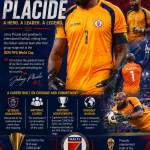
The Final Whistle: Johny Placide’s Farewell to Professional Football

An expert look back at the career of Haiti’s longest-serving captain, who bowed out on the sport’s biggest stage

Introduction

There is a particular kind of symmetry in a goalkeeper’s career ending in the same place it once felt impossibly far away. For Johny Placide, that symmetry arrived on June 24, 2026, in Atlanta, in a frantic 4-2 defeat to Morocco that closed out Haiti’s long-awaited return to the FIFA World Cup. Haiti’s goalkeeper announced he would end his international career after the Grenadiers’ final match against Morocco at the 2026 FIFA World Cup. Days later, his contract with French Ligue 2 side SC Bastia also reached its natural conclusion, closing two chapters of a career that had spanned nearly two decades, three countries, and a Caribbean nation’s most improbable football story.

Early Life and the Long Road Through France

Born on 29 January 1988 in Montfermeil, France, to Haitian parents, Placide holds dual French-Haitian citizenship and stands at 1.81 metres tall, favouring his right foot. He began his career on the youth side with Le Havre and was promoted to the first team in July 2008, playing four games in his first season. He made his debut on 26 April 2009 against Grenoble. It was at Le Havre that Placide first announced himself as a serious goalkeeping talent: he won the UNFP Ligue 2 Goalkeeper of the Year award in 2011, recognizing his 16 clean sheets in the 2010–11 season.

Placide joined Reims in January 2013, making his league debut on 19 January 2013 in a 1–0 away defeat to Sochaux. He went on to make 53 appearances in Ligue 1 with Reims until his release in July 2016. A brief, frustrating stint followed at Guingamp, where despite his prior Ligue 1 experience, he failed to make a single first-team appearance, remaining behind established goalkeeper Ludovic Briand in the pecking order.

Rather than let that setback define him, Placide rebuilt his career abroad. On 31 August 2017, he signed a two-year contract with League One side Oldham Athletic, making his debut on 26 September 2017 in a 3–2 victory over Peterborough United, a performance that earned him the man of the match award. He quickly became Oldham’s first-choice goalkeeper, making 36 appearances in the 2017–18 League One season. From England, he moved further afield still: he spent 2019 to 2021 with Tsarsko Selo in Bulgaria’s First League, making 48 appearances and helping the club secure top-flight survival via a playoff win over Septemvri Sofia.

Finding a Home at Bastia

On 5 June 2021, Placide signed for newly-promoted Ligue 2 club Bastia. It would prove to be the longest and most stable stint of his club career, and the one in which he became a true fixture. By the time of his contract extension in 2025, Placide had made 121 appearances for Bastia, including 45 clean sheets — a record his club hailed as making him one of the best goalkeepers in the division. That extension, signed on 9 June 2025, ran his deal through to 30 June 2026 — a date that, fittingly, arrived just days after his final World Cup appearance for Haiti. Across his final Ligue 2 season with the club, Placide maintained a save percentage above 67% and an average match rating of 6.8, continuing to perform at a high level even as he entered his late thirties.

Captaining the Grenadiers: An International Career Spanning 15 Years

While Placide built a steady, well-travelled club career across France, England, and Bulgaria, it was in Haiti’s colours that he became a genuine icon. Placide has played for and captained the Haiti national team since 2011. He was first named a starter in November 2011, in a World Cup qualifier against Antigua and Barbuda — the beginning of a journey that would span nearly 15 years under the Haitian crest.

The defining moment of that international career came in the summer of 2019. Although Placide had already established himself as Haiti’s first-choice goalkeeper, the 2019 CONCACAF Gold Cup elevated his reputation to a new level. Playing alongside teammates such as Duckens Nazon, Wilde-Donald Guerrier, Bryan Alceus, Frantzdy Pierrot, and Ricardo Adé, his leadership and crucial saves helped Haiti reach the semifinals — one of the greatest achievements in the country’s football history. Haiti topped Group C with victories over Bermuda (2–1), Nicaragua (2–0), and Costa Rica (2–1), before progressing past Canada 3–2 on penalties in the quarter-finals, ultimately falling 1–0 to Mexico in extra time in the semi-finals.

Through three failed World Cup qualifying cycles — the 2014, 2018, and 2022 campaigns, none of which delivered Haiti to “the promised land” — Placide remained the constant presence between the posts, the senior figure tasked with steadying a team that kept just missing the breakthrough it craved. By the time qualification for 2026 finally arrived, Placide had become the veteran statesman of the squad, explaining his role: “I have the role of all the veterans: to bring composure to the group, to help new players understand what it means to represent the Haitian crest, our responsibility to the country, our mission.”

The World Cup at Last — and a Decision Already Made

On 15 May 2026, Placide was named in the 26-man Haiti squad selected by head coach Sébastien Migné for the 2026 FIFA World Cup — his first senior World Cup appearance, arriving at the age of 38. It was the culmination of everything: a goalkeeper who had spent a decade and a half carrying Haiti’s hopes through near-misses finally got to live the moment in person, in front of a global audience, as his country’s captain.

But Placide had already decided this would be his final act. Asked about a potential appearance at the 2027 Gold Cup, following Haiti’s 3-0 defeat to Brazil on 19 June, the goalkeeper was unequivocal: “Me, I won’t be at the Gold Cup. There’s still one match left [in this World Cup] and after that, it’s over.” The announcement marked the end of a journey of nearly 15 years in the Haitian shirt. Having been a starter as far back as November 2011, Placide departed the Grenadiers as the most-capped active player on the national team.

True to his word, he carried his country through to the very last whistle. In Haiti’s group-stage finale against Morocco in Atlanta, with qualification already gone, Placide produced one final reminder of his class: a remarkable double save that helped preserve Haiti’s lead during the wild 4-2 thriller, a moment that earned recognition as one of the standout goalkeeping moments of the tournament’s group stage. It was a fitting final image — pure reflexes and refusal to fold, even with nothing left to play for but pride.

Career Highlights at a Glance

  • UNFP Ligue 2 Goalkeeper of the Year (2011) — earned at Le Havre for a 16-clean-sheet season
  • 84 caps for Haiti, making him the national team’s most-capped active player at the time of his retirement
  • 2019 CONCACAF Gold Cup semi-finalist — Haiti’s deepest-ever run in the competition, built on Placide’s saves and leadership
  • 121 appearances and 45 clean sheets for SC Bastia across five seasons, making him one of the club’s most respected modern goalkeepers
  • Three World Cup qualifying cycles weathered (2014, 2018, 2022) before finally captaining Haiti to the 2026 finals
  • 2026 FIFA World Cup debut at age 38 — his first and only senior World Cup, capped by a string of vital saves against Morocco in his farewell appearance
  • Long-serving captain of the Haiti national team, a role he held for the majority of his international career

A Fitting Farewell

Johny Placide’s career was never defined by major trophies — a reflection of his affiliations with mid-tier clubs competing for survival or consolidation rather than titles — but by something arguably rarer: durability, leadership, and an unshakable sense of duty to a shirt that carried far more weight than club football ever could. He spent the best part of two decades being the dependable last line for both club and country, never quite the headline name, always the steadying presence others leaned on.

That he chose to walk away exactly when Haiti’s 52-year World Cup wait finally ended — going out not with a trophy, but with a string of brave saves in a breathless, high-scoring farewell against Morocco — feels entirely in keeping with the player he was throughout his career. Johny Placide didn’t get the storybook ending of victory. He got something that may matter more to the people who watched him: he was there, between the posts, right until the very last moment Haiti needed him.

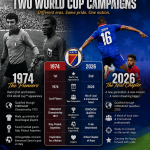
1974 vs. 2026: Comparing Haiti’s Two World Cup Campaigns

An expert statistical and contextual breakdown of Les Grenadiers’ debut and their long-awaited return, 52 years apart

Introduction

Separated by 52 years, two oceans of footballing change, and an entire diaspora’s worth of migration, Haiti’s two FIFA World Cup campaigns — 1974 in West Germany and 2026 across the United States — offer a fascinating case study in how a small footballing nation’s fortunes can shift, and how some things never change. Haiti have appeared twice at the FIFA World Cup, in 1974 and in 2026, and both times they were eliminated at the group stage without winning a match. But beneath that shared headline lies a far more nuanced story. Here is the full statistical and contextual comparison.

Group Draws: Two Brutal Tests

1974 — Group 4 (West Germany, Italy, Argentina, Poland… minus West Germany): Group 4 of the 1974 FIFA World Cup pitted Italy (Pot 1, Western Europe), Poland (Pot 2, Eastern Europe), Argentina (Pot 3, South America), and Haiti (Pot 4, Rest of the World) against one another. It was, by any measure, one of the toughest groups in tournament history — Italy were the reigning runners-up from the previous World Cup, Argentina featured Mario Kempes, and Poland, inspired by Grzegorz Lato, would go on to finish third overall.

2026 — Group C (Brazil, Morocco, Scotland): Haiti’s modern return was no gentler. They were drawn against five-time champions Brazil, North African powerhouse Morocco, and a resurgent Scotland making their first World Cup appearance since 1998. Both eras, then, share a defining trait: Haiti has never once been handed an easy group.

Head-to-Head Comparison: Match Results

19742026
Match 1Italy 3, Haiti 1 Scotland 1, Haiti 0
Match 2Poland 7, Haiti 0 Brazil 3, Haiti 0
Match 3Argentina 4, Haiti 1 Morocco 4, Haiti 2

Head-to-Head Points

Since each individual match in a group stage is its own discrete contest, “head-to-head points” effectively mirrors overall group points in both campaigns:

  • 1974: Haiti finished with 0 points from 3 matches (0 wins, 0 draws, 3 losses).
  • 2026: Haiti also finished with 0 points from 3 matches (0 wins, 0 draws, 3 losses) — a result formalized once Morocco closed out a 4-2 win in the final group match in Atlanta.

Verdict: Dead even. Across 52 years and two completely different generations of players, Haiti’s points return at the World Cup has not improved by a single point.

Head-to-Head Goal Difference (vs. group opponents only)

  • 1974: 2 goals scored, 14 conceded → -12 goal difference
  • 2026: 2 + 0 + 2 = 4 goals scored… wait — let’s be precise. Haiti scored 1 vs Scotland? No — Haiti scored 0 vs Scotland, 0 vs Brazil, and 2 vs Morocco. Total: 2 goals scored, 8 conceded → -6 goal difference

Verdict: 2026 is a clear improvement. Haiti conceded only 8 goals across the modern campaign compared to 14 in 1974, halving their defensive damage despite facing arguably similar (if not tougher, given Brazil’s pedigree) calibre of opposition.

Head-to-Head Goals Scored (vs. group opponents only)

  • 1974: 2 goals scored across the tournament — both netted by Emmanuel Sanon, against Italy and Argentina respectively.
  • 2026: 2 goals scored — both arriving in the final, already-academic match against Morocco: Lenny Joseph’s opener in the 10th minute and Wilson Isidor’s spectacular long-range strike in the 43rd minute.

Verdict: Tied at two. Remarkably, across two World Cups spanning more than half a century, Haiti has scored exactly two goals each time. Indeed, Haiti had scored only two goals in its entire World Cup history prior to the Morocco match — and matched that tally within a single half of their 2026 finale.

Overall Goal Difference (Tournament-wide)

These figures are identical to the head-to-head numbers above, since Haiti’s entire group-stage campaign in both years consisted only of group matches with no further fixtures played.

  • 1974: -12 (2 scored, 14 conceded)
  • 2026: -6 (2 scored, 8 conceded)

Verdict: 2026 nearly halves the goal-difference deficit of 1974, a meaningful defensive improvement even allowing for the fact that both campaigns ended without a win.

Overall Goals Scored (Tournament-wide)

Identical to the head-to-head figures: 2 goals in 1974, 2 goals in 2026. The symmetry is one of the more remarkable footnotes in Haitian football history — two completely different generations of players, 52 years apart, finishing with the exact same tally.

Fair Play Score

This is where the two campaigns diverge most sharply in terms of available data. FIFA’s team conduct (“fair play”) score is used as a tiebreaker for group standings and third-place rankings when head-to-head and overall records are tied — but this metric, in its modern form (based on yellow/red cards and other disciplinary records), was not a recognized part of World Cup tiebreaker procedure in 1974. Disciplinary statistics from the 1974 tournament exist in limited archival detail, but no comparable “fair play score” was compiled or published for that era in the way FIFA does today. Since Haiti finished bottom of their respective groups in both tournaments without needing a tiebreaker, fair play scores were not a deciding factor in either campaign — but a direct numerical comparison between the two eras isn’t possible due to the absence of a standardized scoring system in 1974.

FIFA World Ranking After the Tournament

This is the most important caveat of the entire comparison: the FIFA World Ranking system did not exist in 1974. FIFA did not introduce its official Men’s World Ranking until August 1992, meaning there is no historical FIFA ranking figure for Haiti immediately following the 1974 World Cup. Haiti’s footballing standing at that time would instead have been judged informally, via regional reputation — Haiti were regarded as roughly the third-strongest team in CONCACAF behind Mexico and arguably Costa Rica during this era.

For 2026, however, the picture is precise and well-documented:

  • Haiti entered the tournament ranked 83rd in the FIFA Men’s World Ranking, the second-lowest ranked team in the entire 48-team field, behind only New Zealand at 85th.
  • After their opening defeat to Scotland, Haiti dropped to 85th, becoming the lowest-ranked team in the entire tournament — below New Zealand.
  • By the time Haiti faced Brazil, they sat 85th with 1,277.67 points, having briefly held 83rd before the Scotland loss pulled them down. Haiti’s all-time highest ranking was 38th, achieved in January 2013, while their lowest-ever ranking was 155th, recorded in April 1966.

Verdict: Not directly comparable, since no ranking existed in 1974 — but the 2026 squad entered the tournament as the lowest- or second-lowest-ranked team in the entire 48-team field, underscoring just how heavily Haiti punched above its statistical weight simply by qualifying for, and competing credibly in, the toughest possible group.

Summary Table

Metric19742026
Group Stage Points00
Wins–Draws–Losses0–0–30–0–3
Goals Scored22
Goals Conceded148
Goal Difference-12-6
Fair Play ScoreNot formally trackedNot a deciding factor
FIFA World Ranking (post-tournament)N/A (system didn’t exist)85th

Final Takeaway

The numbers tell a story of remarkable consistency layered with quiet improvement. Haiti’s two World Cup campaigns produced identical points totals (zero) and identical goal tallies (two), yet the 2026 vintage conceded almost half as many goals as their 1974 predecessors did against, arguably, an even more star-studded gauntlet of opposition. Both Haitian goals in 2026 came in a thrilling, ultimately academic 4-2 defeat to Morocco — fittingly mirroring 1974, when both of Haiti’s goals also came from a single, iconic source: Emmanuel Sanon.

What separates the two campaigns most is not the scoreboard, but the context surrounding it. The 1974 squad were entirely homegrown, having risen through Haiti’s domestic league before facing the world. The 2026 squad, assembled largely from the European-based diaspora, represented a fundamentally different model of national team building — one shaped by 52 years of Haitian migration to France, the United States, and beyond. Whether judged on the pitch or through the broader lens of footballing identity, both Haitian sides left the World Cup having lost every match, yet both also left having mattered: 1974 for Sanon’s goal against Dino Zoff, and 2026 for a chaotic, four-goal thriller in Atlanta that gave a new generation of Haitian fans something to sing about.

Wilson Isidor: From Rennes to the World Cup — Haiti’s Late-Arriving Sunderland Striker

An expert profile of the Premier League forward whose international switch reshaped Haiti’s attack ahead of its historic 2026 World Cup return

Introduction

Few stories at the 2026 FIFA World Cup capture the modern complexity of national identity in football quite like that of Wilson Isidor. A Premier League striker who came through one of France’s finest academies and represented his country of birth at every youth level, Isidor made the deeply personal choice — just months before the tournament — to wear the colours of Haiti instead. The decision turned him from a promising Sunderland forward into one of the most talked-about additions to Les Grenadiers’ historic World Cup squad, and by the group stage’s final round, he had already delivered one of the goals of the tournament.

Early Life and Background

Wilson Isidor was born on 27 August 2000 in Rennes, France. His parents are from Haiti, and he is of Haitian and Malagasy descent through his mother’s side. He came up through SC Le Rheu before joining the academy of Stade Rennais FC in 2009, where he stayed until 2018 — the same storied Rennes academy that has produced a string of French internationals. He represented France at youth level, from U-17 to U-20, and was once considered a potential option for the senior French national team.

Climbing the Ladder: The Club Career

Monaco (2018–2021). Isidor made his professional debut with Monaco on 11 November 2018, in a 4–0 Ligue 1 loss to Paris Saint-Germain. The move from Rennes to the principality club put him in one of France’s most productive academies for attacking talent. To gain experience, he had loan spells in the Championnat National with Laval in the 2019–20 season and with Bastia-Borgo in 2020–21, where he was named the Championnat National’s revelation of the season — a breakout campaign that confirmed his goal-scoring potential outside the top flight.

Lokomotiv Moscow (2022–2023). On 22 January 2022, Isidor signed a 4.5-year contract with Russian club Lokomotiv Moscow. His start there was sensational: he scored at least once in each of his first six games in the Russian Premier League, matching a record for the most consecutive games with a goal at the start of a league career, and was named the Russian Premier League’s Player of the Month for April 2022.

Zenit St. Petersburg (2023–2025). Isidor was transferred to Zenit, where he went on to win three titles across his career: the Russian Premier League in 2023/24, the Russian Super Cup in 2024/25, and the Russian Cup in 2023/24.

Sunderland (2024–present). Isidor initially joined Sunderland on loan from Zenit in August 2024, scoring nine goals before the club triggered the purchase option. On 1 February 2025, he signed a permanent deal with Sunderland on a contract running until the summer of 2028. The move proved transformative for both player and club. On 9 May 2025, Isidor scored in Sunderland’s 2–1 away win over Coventry City in the first leg of their Championship play-off semi-final, helping the club push towards promotion. Sunderland’s promotion push succeeded, and Isidor was there to mark the club’s top-flight return in style: on 16 August 2025, he scored Sunderland’s third goal in a 3–0 win over West Ham on the club’s return to the Premier League. In his first season back in England’s top division, he recorded six goals in the 2025/26 Premier League campaign.

The International Crossroads: Choosing Haiti

For years, Isidor’s international future appeared tied to France. That changed in early 2026, as Haiti’s qualification for its first World Cup since 1974 set off a wave of outreach to diaspora-born talent. After months of public campaigning by Haitian fans on social media urging him to join Les Grenadiers, Isidor announced his decision to switch allegiance, just three months before the tournament. In a clip posted by the Haitian Football Federation, he said in Creole: “You asked for me. You believe in me. You waited for me. Today, I come to tell you: here, I am.”

Isidor explained the personal weight of the choice: “My grandpa and my dad were born in Haiti,” he said. “Because I’m French, it was difficult to make a choice. I had to choose between my mum and my dad! I’m really happy with that choice. I’m learning a lot about the country and learning about the culture.” He was named in Haiti’s squad for friendly matches against Tunisia and Iceland in March 2026, and the switch carried symbolic weight at club level too: by representing Haiti, Isidor became the first Haitian player to have played for Sunderland.

Announcing the decision, Isidor wrote on social media: “I am proud to now be part of the national team and be able to bring honour to our people, to our nation. Together, we have the opportunity to make history and experience great adventures.” On 15 May 2026, he was officially included in head coach Sébastien Migné’s 26-man squad for the FIFA World Cup.

Performance at the 2026 FIFA World Cup

Drawn into a daunting Group C alongside Brazil, Morocco, and Scotland, Haiti’s first World Cup appearance in 52 years was always going to be a steep test — and Isidor was thrust straight into the heart of it as the team’s lead striker.

Match 1 — Scotland 1-0 Haiti (Foxborough/Boston, June 13/14). Isidor started Haiti’s historic World Cup return, but the Grenadiers were undone by a scrappy McGinn rebound, falling to defeat in their first World Cup match since 1974.

Match 2 — Brazil 3-0 Haiti (Philadelphia, June 19). Haiti suffered another defeat, this time 3-0 to Brazil, confirming their elimination from the tournament before the final group game had even been played.

Match 3 — Morocco vs Haiti (Atlanta, June 24). With qualification already gone, Isidor delivered one of the standout individual moments of the entire tournament. After Lenny Joseph’s early opener deflected in off the Moroccan goalkeeper in the 10th minute and Achraf Hakimi leveled for Morocco in the 39th, Isidor restored Haiti’s lead with a sublime long-range strike — a genuine contender for goal of the tournament. The Sunderland forward collected the ball on the right edge of the penalty area, shifted it onto his right foot to create space, and unleashed an unstoppable rocket that flew across the goal and into the top-left corner, sending the Mercedes-Benz Stadium crowd into a frenzy. Morocco’s Ismael Saibari restored parity in stoppage time, sending the teams in level at 2-2 at the break, before Haiti’s Josué Casimir struck again early in the second half to put Les Grenadiers back in front.

(Note: At the time of writing, the Morocco–Haiti match was still in progress in the second half. Readers should check the latest score for the confirmed full-time result.)

What Isidor’s World Cup Means

Whatever the final scoreline against Morocco, Isidor’s tournament will be remembered as a personal triumph layered onto a broader national story. A Premier League striker who could easily have spent his career chasing a France cap instead chose to write Haitian football’s next chapter — and did so by scoring one of the most memorable individual goals of the entire 2026 World Cup group stage.

For Haiti, already eliminated by the time he struck that rocket into the top corner, Isidor’s goal was about something larger than the table: proof that the influx of elite diaspora talent — Isidor, Bellegarde, Casimir, Joseph and others — has given Les Grenadiers a ceiling far higher than anything the nation has had access to since 1974. Whether Isidor continues with Haiti beyond this tournament or simply treats it as a career-defining chapter, his World Cup debut has already secured him a lasting place in the country’s footballing memory.

Lenny Joseph: The Late-Blooming Forward Carrying Haiti’s World Cup Dream

An expert breakdown of the Haitian forward’s journey from French lower-league football to the biggest stage in the sport

Introduction

Of all the storylines woven through Haiti’s first World Cup appearance in 52 years, few capture the spirit of “Les Grenadiers” quite like that of Lenny Joseph. A forward who spent the best part of a decade grinding through France’s lower divisions before ever wearing the Haitian crest, Joseph arrived at the 2026 FIFA World Cup as a first-time call-up — and within three matches, etched his name into the history books by scoring Haiti’s first-ever goal of the tournament.

Early Life and Background

Lenny Joseph was born on 12 October 2000 in Paris, France, and holds dual French-Haitian citizenship, standing 1.83 metres tall and playing predominantly with his right foot. He was born in France to a Haitian father and a DR Congolese mother, which made him eligible to represent either France or Haiti at international level. Like so many of his current Haiti teammates, Joseph’s path to international football reflects the realities of the Haitian diaspora: a footballer raised and developed entirely within the French system, who ultimately chose to represent the land of his father’s heritage.

Climbing Through the Ranks: The Club Career

Joseph’s professional journey was far from a fast-tracked academy rise. It was built, instead, on patience and steady improvement through some of French football’s less glamorous corners.

Le Puy and Boulogne (2019–2021). His career began in the lower tiers of French football with Le Puy Foot 43, where he developed into a prolific scorer in the National 2 division, netting 10 goals across 18 appearances between 2018 and 2021. He also spent time with the reserves of Boulogne during this period. It was a breakout run in the 2020-21 Coupe de France — France’s national cup competition, famous for giving amateur and lower-league clubs a shot at giant-killing — that first turned heads. He reached the last 16 of the French Cup with Le Puy that season thanks to standout performances, which attracted the attention of top-flight club Metz.

FC Metz (2021–2023). Joseph signed a professional contract with Metz in the summer of 2021 and made his professional debut in a 3–3 Ligue 1 draw with Lille on 8 August 2021. He went on to make his top-flight debut in Ligue 1 and contributed three goals in 29 Ligue 2 matches the following season, after the club’s relegation. In total, he recorded one goal in three Coupe de France appearances with Metz. Across his two years with Metz, he made 40 appearances in total, scoring four goals, playing in both the first and second divisions of French football.

Grenoble Foot 38 (2023–2025). Joseph signed for second-division side Grenoble in the summer of 2023, and over the following year and a half played 56 games, scoring eight goals and recording eight assists. It was a productive, if unspectacular, stint that nonetheless kept building his case for a move to a higher level.

Ferencvárosi TC (2025–present). On 20 January 2025, Joseph was signed by Hungarian league club Ferencvárosi TC — Hungary’s most successful and storied club, commonly known as Fradi. The move marked his first stint abroad, joining the reigning Nemzeti Bajnokság I champions as a centre-forward. His integration was gradual at first, but he soon became a regular contributor. In the 2025–26 season, Joseph made 25 league appearances scoring seven goals and adding one assist, while also featuring 12 times in the Europa League, scoring twice and assisting twice. On 9 May 2026, he won the 2025–26 Magyar Kupa (Hungarian Cup) with Ferencváros, beating Zalaegerszegi TE 1–0 in the final at the Puskás Aréna — the first major trophy of his career.

The Call-Up: Joining Les Grenadiers

For years, Joseph’s name was absent from Haiti’s national team conversation. That changed dramatically in 2026, as coach Sébastien Migné assembled a World Cup squad built largely around the diaspora. In May 2026, Joseph was called up for the FIFA World Cup to represent the Haiti national team for the first time, joining a wave of other first-timers. He was one of the notable first-time call-ups in Haiti’s roster, alongside midfielder Dominique Simon, both players competing for top-tier clubs in Europe — Joseph at Ferencvárosi TC in Hungary and Simon at FC Tatran Prešov in Slovakia.

Joseph made the final 26-man squad as a 25-year-old forward, wearing the number 16 shirt for Les Grenadiers. It capped an unlikely rise for a player who, just a few years earlier, had been grinding out minutes in France’s third and fourth tiers.

Performance at the 2026 FIFA World Cup

Haiti were drawn into a brutal Group C alongside Brazil, Morocco, and Scotland — arguably the toughest possible return to the World Cup stage after a 52-year absence.

Match 1 — Scotland 1-0 Haiti (Foxborough, June 13/14). Joseph started in Haiti’s historic World Cup return after 52 years away, but the Grenadiers fell to a narrow defeat, beaten by a John McGinn rebound after a Ché Adams effort was saved.

Match 2 — Brazil 3-0 Haiti (Philadelphia, June 19). A clinical Brazilian display, led by Vinícius Júnior and Matheus Cunha, left Haiti without a goal and already eliminated from World Cup contention after two matches.

Match 3 — Morocco vs Haiti (Atlanta, June 24). Needing nothing but pride, Joseph delivered the moment Haitian football had craved for over half a century. Joseph received an assist from Jean-Kévin Duverne on the right flank and was waiting at the center of the box to knock the ball in — Haiti’s first goal of the 2026 World Cup. The strike came in the 10th minute, deflecting in for what was recorded as an own goal off Morocco goalkeeper Yassine Bounou, but it was Joseph’s effort that forced the moment. Prior to that goal, Haiti had scored only two goals in its entire World Cup history — and Joseph’s effort meant the team matched that tally inside a single half. The match itself turned into an instant classic, with Morocco’s Achraf Hakimi equalizing before Wilson Isidor restored Haiti’s lead with a stunning long-range strike, only for Ismael Saibari to level it again for Morocco in stoppage time, sending the sides in level at 2-2 at the break.

(Note: At the time of writing, the Morocco–Haiti fixture was still unfolding into the second half, with the final result not yet determined. Readers should check the latest score for the full-time outcome.)

What Joseph’s Tournament Means

Even with Haiti’s group-stage exit confirmed before a ball was kicked against Morocco, Joseph’s contribution carries real weight in the context of Haitian football history. His goal against Morocco ended a 52-year wait for the nation to find the net at football’s biggest tournament outside of the legendary 1974 campaign, and did so on a global stage shared with the likes of Brazil’s Neymar and Vinícius Júnior.

For a player who spent his early twenties working his way up through France’s National 2, Ligue 2, and the Hungarian top flight, scoring at a World Cup represents the unlikely peak of a career built on persistence rather than precocity — and a moment that will be remembered fondly by the Haitian diaspora regardless of where Les Grenadiers finish in the final standings.

Inside the American Soccer Pyramid: How Clubs Are Sanctioned, Financed, and Funded From MLS on Down

Ask a fan in England how their local club moved from the fourth tier to the Premier League, and they’ll tell you a story about promotion battles, playoff heartbreak, and years of climbing the table. Ask an American fan the same question about, say, Charlotte FC or St. Louis CITY SC, and the answer is completely different: an ownership group wrote a check for hundreds of millions of dollars, and a league voted them in.

That difference is the key to understanding American soccer. The United States doesn’t have a soccer pyramid in the global sense — interconnected divisions where results on the field determine who rises and who falls. It has something more like a set of parallel professional tiers, each independently sanctioned, each with its own owners, and each governed from above by a single national body: the United States Soccer Federation.

U.S. Soccer’s Role: Sanctioning, Not Running

U.S. Soccer is the country’s official governing body for the sport — a nonprofit, FIFA-affiliated organization responsible for the national teams, referee standards, coaching licenses, and the domestic league system. But its most consequential power, for the business side of the sport, is sanctioning: deciding which professional leagues are allowed to operate at which level.

U.S. Soccer does not own, operate, or directly run any of the leagues beneath it. Major League Soccer runs itself. So does the USL. What U.S. Soccer does is publish and enforce a set of rules called the Professional League Standards (PLS) — and a league either meets them, or it doesn’t get the division designation it’s asking for.

This is the same basic system that doomed the original North American Soccer League revival in the 2010s. The NASL operated as a sanctioned Division II league from 2011 through 2016, but when its team count fell under the 12-team threshold in 2017, U.S. Soccer only granted it provisional status. When the league couldn’t present a credible plan to meet full Division II standards for 2018, the Federation rejected its application outright. The NASL sued U.S. Soccer over the decision, the legal fight dragged on for years, and the league itself folded before it was ever resolved — a federal jury didn’t dismiss the case until February 2025. It’s a useful reminder that in American soccer, a league’s survival can hinge as much on a compliance filing as on anything that happens on the pitch.

Why There’s No Promotion or Relegation (Mostly)

In most of the world, divisions are connected: the bottom clubs in one tier drop down, the top clubs in the tier below move up, and a result in March can change a team’s entire future. The United States has never worked this way, for the same reason none of the country’s other major sports leagues do — every major American league, in every sport, is a closed system built around expansion fees and franchise ownership rather than sporting merit.

That single fact shapes almost everything else about the structure: clubs generally enter a division by being admitted (and paying for the privilege), not by climbing into it.

That is now, finally, starting to change. In March 2025, the USL announced plans to introduce the first promotion-and-relegation system in the history of major American pro sports, linking USL League One, the USL Championship, and a new USL first division slated to launch around 2028. The timing isn’t an accident — USL executives have been explicit that the 2026 World Cup and the 2028 LA Olympics represent a moment to build something that looks more like the global game. But the rollout is genuinely complicated, because U.S. Soccer’s existing Professional League Standards were written for closed leagues. A team that earns promotion on the field might not have the stadium capacity or ownership net worth the next division requires — a problem soccer fans elsewhere in the world simply don’t have to think about. MLS, notably, has shown no indication it will ever join this kind of system; it remains committed to its closed, expansion-driven model.

The Men’s Professional Structure, Division by Division

As things stand today, U.S. Soccer recognizes three sanctioned divisions of men’s outdoor professional soccer.

Division I — Major League Soccer. MLS has been the sole Division I league since 1996, when it launched with 10 teams. It now fields 30 clubs across the U.S. and Canada, having grown steadily — and in recent years explosively — through new expansion franchises like St. Louis CITY SC, Charlotte FC, and San Diego FC.

Division II — USL Championship. The USL Championship is currently the only sanctioned Division II men’s league, with roughly two dozen clubs spread across Eastern and Western conferences. It sits below MLS but above the lower minor-league tiers, serving as a landing spot for markets that aren’t (yet) ready for an MLS bid, as well as a proving ground for ownership groups hoping to eventually move up.

Division III. This tier currently includes USL League One and MLS Next Pro, the reserve-and-development league MLS created in 2022 so its academy prospects and young signings could get competitive minutes without occupying an MLS roster spot. A handful of other Division III hopefuls, like NISA, have come and gone or lost sanctioning entirely in recent seasons — a reflection of how difficult it is to sustain a professional league at the lower levels of American soccer.

Below Division III, the pyramid effectively stops being a pyramid in any formal sense. Leagues like USL League Two and the National Premier Soccer League operate at a high amateur or semi-pro level — sometimes informally called “Division 4” — but U.S. Soccer doesn’t sanction anything below Division III, and amateur soccer is instead overseen separately by the United States Adult Soccer Association (USASA).

The Financial Bar for Launching a Club

This is where U.S. Soccer’s rules get specific, and where the real gatekeeping happens. The Professional League Standards lay out detailed financial, operational, and facility requirements for each division — and while the Federation is relatively flexible on some organizational details, it is strict about proof of financial viability.

Ownership net worth. This is the headline requirement. To sanction a Division I league, U.S. Soccer requires that the principal owner of each club — together with the rest of that club’s ownership group — hold a combined net worth of at least $70 million, not counting the value of their stake in the team itself or their primary residence. Division II ownership groups need a principal owner with at least $20 million in net worth and at least a 15% stake in the club; Division III drops that bar to $10 million and the same 15% stake. The Federation reserves the right to demand an independent financial audit to verify these figures, at the club’s expense.

Performance bonds. Beyond net worth, clubs must post a bond or letter of credit with the league or Federation to cover potential shortfalls — things like unpaid player salaries or stadium lease obligations if a club runs into financial trouble mid-season. At the Division II level, that bond runs $750,000 per team; Division III sits lower, around $250,000.

League scale and geography. A league itself needs a minimum number of teams to even apply — eight for Division II, growing to 12 within six years — spread across multiple U.S. time zones, with a set percentage of clubs located in metro markets above a defined population threshold (1 million or more for Division I, 750,000 for Division II).

Stadiums and broadcast. Clubs need a minimum seating capacity (5,000 for Division II, for example) on a FIFA-approved playing surface, with a signed lease in hand well before the season starts. Division I leagues must also have broadcast or streaming contracts covering every regular-season and championship game.

Player development. Every club must maintain some form of player development pipeline — typically a youth academy — reflecting U.S. Soccer’s broader push to connect the professional game to the country’s grassroots talent pool.

Layer all of this on top of league-specific expansion fees, and the price of entry becomes enormous. MLS’s most recent expansion club, San Diego FC, paid a reported $500 million just for the right to join the league in 2025 — a staggering jump from the $30-40 million fees the league was charging as recently as the late 2000s, and worlds away from the $10 million Toronto FC paid to join less than two decades earlier. That escalation says less about inflation than about what investors believe MLS franchises are now worth.

How MLS Actually Makes Money

To understand MLS revenue, you first have to understand that, legally, MLS clubs don’t fully exist as independent businesses. The league operates under a “single-entity” structure: Major League Soccer, L.L.C. centrally owns every team, every player contract, and every league trademark. What fans call “owners” are technically investor-operators — partners in the league itself who are granted the right to operate one franchise. This structure, born out of the financial chaos that killed earlier American soccer leagues, was upheld by federal courts specifically because a single entity legally cannot be accused of conspiring against itself on matters like salary caps.

That structure determines who keeps what.

Centralized, league-wide revenue includes national media rights, league-level sponsorships, expansion fees, and the league’s commercial arm, Soccer United Marketing (SUM) — the for-profit entity that sells the combined commercial rights to MLS, the U.S. men’s national team, and (through other arrangements) several other competitions across the region, including Leagues Cup. This pool of money gets distributed across all 30 clubs, regardless of market size.

MLS’s media-rights arrangement has been especially unusual by American sports standards. In 2022, the league signed a 10-year, $2.5 billion global deal with Apple, making MLS the first major property to abandon traditional cable and broadcast television in favor of an exclusive streaming partnership — every match available worldwide through a single subscription, MLS Season Pass. That experiment is now being revised: in late 2025, MLS and Apple agreed to fold all matches directly into the standard Apple TV subscription starting in 2026, ending the standalone Season Pass product, while also restructuring the payment schedule and shortening the deal’s term. Apple will pay roughly $200 million for the 2026 season alone. The league is simultaneously shifting to a fall-to-spring calendar aligned with the rest of the global soccer schedule, starting in 2027 — a change aimed at reducing fixture conflicts and making it easier for MLS clubs to participate in the international transfer windows that the rest of the soccer world runs on.

Club-level, locally retained revenue is where individual teams differentiate themselves. Each investor-operator generally keeps the bulk of:

  • Ticket sales and matchday income — though clubs typically remit a share, commonly cited around 30%, of gate receipts back to the league.
  • Local sponsorships and jersey deals — front-of-jersey sponsorships average a few million dollars annually league-wide, with the league’s marquee clubs commanding far more.
  • Stadium naming rights — LAFC’s deal for Banc of California Stadium, for instance, was reported at $100 million over 15 years.
  • Concessions, parking, and non-soccer stadium events like concerts.
  • Merchandise sold at the stadium (though online league merchandise sales are centralized).
  • Player transfer fees, when a club sells a player abroad, split with the league under a formula based on percentage thresholds.

The result is enormous variance between clubs. Inter Miami, boosted by the Lionel Messi effect, generated an estimated $190 million in revenue in a recent season — split roughly evenly between matchday and commercial income, on top of a modest league distribution — while a smaller-market club like the Vancouver Whitecaps sat closer to $47 million. Markets without their own soccer-specific stadium have historically struggled the most: NYCFC spent years playing “home” games across half a dozen different rented baseball and football stadiums, missing out entirely on premium seating and certain categories of sponsorship before finally opening a venue of its own.

Revenue Below MLS

Clubs in the USL Championship and USL League One operate independently rather than under a single-entity model — each franchise is its own business, responsible for its own sponsorships, ticketing, and local broadcast arrangements, without a centralized SUM-style revenue engine behind it. That independence cuts both ways: a well-run USL club in a passionate mid-sized market can punch above its weight commercially, but without the kind of national media deal MLS enjoys, most of the financial burden of building a sustainable business — stadium costs, payroll, travel — falls on local revenue alone. It’s a major reason why expansion fees at the USL level, while still substantial, remain a fraction of what MLS now commands, and why the financial thresholds U.S. Soccer requires for Division II and III sanctioning are correspondingly lower than what it demands at the top.

The Bigger Picture

Put it all together, and the American system reveals its underlying logic. U.S. Soccer doesn’t pick winners on the field — it sets a financial and operational floor, and lets capital decide who clears it. Leagues compete to meet that floor in exchange for a division designation; clubs that join pay enormous sums for the privilege of being inside a closed, centrally negotiated revenue system; and the country’s signature import from European football — promotion and relegation — is only now, tentatively, being tested at the USL level, decades after MLS chose stability and expansion fees over sporting risk.

Whether that experiment changes the shape of the pyramid by the 2030s remains an open question. But for now, in American soccer, the surest way to reach the top division isn’t to win your way there. It’s to write the check.

Fifty-Two Years in the Wilderness: How Haiti’s Grenadiers Fought Through Dictatorship, Disaster, and Gang Warfare to Return to the World Cup

There is a moment in November 2025, in a half-empty municipal stadium 500 miles from home, that tells you almost everything you need to know about Haitian football. Les Grenadiers, playing a “home” World Cup qualifier against Nicaragua, score twice and hold on for a 2-0 win. Back in Port-au-Prince, a city under partial gang control, with a national stadium that no longer belongs to the federation that owns it, people pour into the streets anyway. They celebrate a World Cup berth their team won without ever touching Haitian soil during the entire qualifying campaign.

It is one of the most improbable stories in the sport’s history — not because Haiti lacks talent, but because almost everything a country needs to develop and sustain a national team has, at one point or another over the last half-century, been taken away from it.

To understand how remarkable Haiti’s return to the World Cup actually is, you have to understand what stood in the way.

Video: AyiboSport on YouTube

A Golden Generation, Strangled by the State (1974–1986)

Haiti’s first and, until now, only World Cup appearance came in 1974 in West Germany, after Les Grenadiers won the Concacaf Championship on home soil in Port-au-Prince the year before. It remains a landmark in Caribbean football — Haiti became the first Caribbean nation to reach the tournament — but the achievement was almost immediately overshadowed by the regime that claimed it as its own.

Jean-Claude “Baby Doc” Duvalier’s government treated the national team less as a sporting asset than a political prop. State officials inserted themselves into team affairs, and the atmosphere around the squad curdled with intimidation and suspicion of match-fixing. The ugliest moment came during the tournament itself, when defender Ernst Jean-Joseph was pulled from the team and publicly humiliated after failing a drug test — an episode many in Haitian football still view as scapegoating dressed up as discipline. A talented generation that might have built on its World Cup debut was instead scattered and demoralized, its momentum killed not by better opposition but by its own government.

Survival Politics, Empty Stadiums (1986–2004)

When the Duvalier dictatorship finally collapsed in 1986, it did not give way to stability. It gave way to nearly two decades of coups, juntas, and assassinated or exiled leaders. Haiti cycled through provisional governments at a dizzying pace, and in a country where the state was fighting for its own survival, youth athletics and domestic leagues were not a priority — they were an afterthought.

Funding for grassroots sports development, which had been thin even under Duvalier, essentially disappeared. Fields went unmaintained. Coaching programs withered. An entire generation of potential players grew up with no structured pathway to the national team, because the institutions meant to build that pathway had been gutted by political emergency after political emergency.

January 12, 2010: The Earthquake That Buried a Stadium

If there is a single point where Haitian sports infrastructure was set back by decades in an instant, it was the magnitude 7.0 earthquake that struck just outside Port-au-Prince on January 12, 2010. The death toll, estimated in the hundreds of thousands, makes any discussion of sports feel almost beside the point — but the disaster’s effect on Haitian football was nonetheless severe and lasting.

The Stade Sylvio Cator, the national stadium and historic home of Les Grenadiers, was badly damaged. Some of the dead were players, coaches, and the youth organizers who ran local clubs and academies — the very people responsible for identifying and developing the next generation of talent. Haiti didn’t just lose a building; it lost institutional memory and human capital that no amount of money could quickly replace.

Hurricane Matthew and the Diversion of Recovery (2016)

Just as the country was clawing its way back, Hurricane Matthew struck in October 2016 as a Category 4 storm, tearing through Haiti’s southern peninsula with catastrophic force. Whatever limited resources existed for rebuilding local pitches, courts, and training facilities were redirected, as they had to be, toward housing, food security, and basic survival. Sports development in the affected regions was pushed even further down a list of national priorities that had never had much room for it to begin with.

Gangs, a Power Vacuum, and a Stadium Lost (2018–2024)

The years following 2018 brought corruption scandals, mass protests, and a political system that was increasingly hollowed out. When President Jovenel Moïse was assassinated in his own home in July 2021, the vacuum at the top of the state accelerated a process already underway: armed gangs began seizing territory across Port-au-Prince, eventually controlling an estimated 80 to 90% of the capital, according to the United Nations.

The consequences for sport were direct and severe. In March 2024, gangs took over Haiti’s longstanding national stadium, the Stade Sylvio Cator, with the Haitian football federation confirming it had lost possession of the facility along with acts of vandalism. No events have been held there since, and it remains unclear if or when the venue could host meaningful matches again. Local football didn’t escape the chaos either — when Violette AC, one of Haiti’s biggest clubs, clinched the domestic league title just weeks before the World Cup, the kickoff of their title-deciding match was delayed by nearby gunfire. The club’s own home ground, the very same Stade Sylvio Cator, had hosted Haiti’s national team matches before gangs took it over.

By the mid-2020s, the human toll of the crisis was staggering: a U.N. human rights report from July 2025 described the situation as an “unending horror story,” with more than 1.3 million Haitians displaced. Youth tournaments and local training sessions, the lifeblood of any football culture, became dangerous simply to organize.

A World Cup Won Entirely Away From Home

This is the backdrop against which Haiti’s 2026 World Cup campaign has to be understood — and it’s why what Les Grenadiers achieved is being described as one of the most remarkable qualification stories in the tournament’s history.

With Sylvio Cator unusable and unsafe, Haiti had no functioning home venue at all. The national team initially tried playing its “home” qualifiers in the Dominican Republic, only for the Dominican government to ban Haitians from entering the country following disputes over undocumented migration. Compounding the logistics, the United States suspended visas for Haitians during this period as well, requiring special exemptions just to let the team travel for tournaments like the Gold Cup. Haiti found itself in the company of nations like Ukraine, Belarus, and Palestine — countries forced by conflict or crisis to attempt World Cup qualification without ever stepping foot on their own soil.

The federation eventually found a workable solution roughly 500 miles offshore: Curaçao, the Dutch Caribbean island, became Haiti’s adopted home for its decisive late-stage qualifiers, with matches against Costa Rica and Nicaragua played at Ergilio Hato Stadium in the capital, Willemstad.

It worked. Haiti’s campaign was built on resilience as much as talent. Les Grenadiers opened with wins over Saint Lucia, Barbados, and Aruba en route to a second-place finish in the second round of Group C. In the final round, against far stiffer Concacaf competition, Haiti fought to a dramatic 3-3 draw at Costa Rica and then defeated Nicaragua 3-0 the following window. Haiti also recorded its first-ever win over Costa Rica in World Cup qualifying history, snapping Los Ticos’ 15-game unbeaten run to open the November window, after rebounding from a 3-0 defeat to Honduras the previous month.

Everything came down to the final matchday. Entering that night’s fixtures, Haiti was tied with Honduras atop Group C, with the group winner claiming the automatic World Cup berth. Playing their adopted “home” match in Curaçao, Les Grenadiers beat Nicaragua 2-0 and, with results elsewhere going their way, claimed top spot in the group to secure direct qualification. The win completed what FIFA itself has called a nearly 52-year absence from the World Cup stage — the joint-fourth longest gap between appearances in tournament history, behind only Wales, Egypt, and Norway.

The team that did it bears little resemblance, demographically, to the federation-run sides of past decades. Many of Haiti’s current national team players were born, raised, and still reside abroad — in countries like France, where they play in European leagues. The diaspora, scattered by exactly the kind of instability described above, has become the engine of Haitian football’s revival. Goalkeeper Johny Placide anchors a roster largely drawn from European and North American clubs, while domestic players like Violette AC’s “Woodensky” — a defensive midfielder raised in the Port-au-Prince slum of Cité Soleil, who was called up by coach Sébastien Migné purely on the strength of online video because Migné had no way to scout him in person — show that talent inside Haiti hasn’t disappeared. It has simply gone unseen, hidden behind a wall of violence that made even watching a match in person too dangerous to attempt.

What Comes Next

Haiti’s reward is a brutal group at the 2026 tournament: Brazil, Morocco, and Scotland, with matches in Boston, Philadelphia, and Atlanta. Haiti will face Scotland on June 13, Brazil on June 19, and Morocco on June 24. Few expect Les Grenadiers to advance out of a group containing a five-time champion and a Morocco side still riding the momentum of its historic 2022 semifinal run. In their only previous World Cup appearance, in 1974, Haiti conceded 14 goals across three group games.

But for a federation that built this entire qualification campaign without a functioning home stadium, without the ability to safely train domestic players, and without the basic infrastructure most nations take for granted, simply arriving at the tournament is the achievement. The result on the pitch in North America this summer will matter far less than what already happened off it: a sport that survived dictatorship, coups, an earthquake, a hurricane, and gang warfare not by waiting for Haiti to become safe again, but by building a team out of whoever and wherever it could.

As one national team player put it, recalling the scenes in Port-au-Prince the night qualification was sealed half a world away in Curaçao — it had been a long time since anyone had seen Haitians united like that.

A Historic Farewell: Haiti and Morocco Meet for the First Time as Group C Reaches Its Finale

Mercedes-Benz Stadium, Atlanta — June 24, 2026

There are matches that decide tournaments, and there are matches that decide nothing on the scoreboard but everything in the memory of a nation. When Haiti and Morocco walk out at Mercedes-Benz Stadium for the final round of Group C fixtures, it will be the first time these two football nations have ever faced each other — at a World Cup or anywhere else. That alone would make this a notable footnote in the history books. The context around it makes it something more.

The Venue: Mercedes-Benz Stadium, Atlanta

Match 50 of the 2026 FIFA World Cup kicks off at 6:00 p.m. ET on Wednesday, June 24, at Mercedes-Benz Stadium in Atlanta, Georgia. The stadium — home of the NFL’s Falcons and MLS’s Atlanta United, and one of the most technologically advanced venues in the world with its retractable roof and 360-degree halo video board — has been one of the showcase venues of the tournament’s group stage.

Fans heading to the match can reach the stadium via the Rapid Atlanta Bus Rapid Transit A-Line, which offers a direct, high-frequency connection from key points across the city, or through accessible drop-off points on both the west (GWCC Bus Lane C) and east (Transportation Terminal) sides of the venue. The match will be broadcast in the United States on FS1 and Telemundo, with streaming available on Peacock.

It is a fitting stage. Atlanta has welcomed the world this June, and on this night it becomes the place where Haiti’s long-awaited World Cup story reaches its final scene — and where Morocco discovers exactly where its own ambitions will take it next.

Why This Match Matters: Haiti’s 52-Year Journey Comes Full Circle

To understand the emotional weight of this fixture, you have to go back more than half a century. Haiti’s only previous World Cup appearance came in 1974, in West Germany, where Les Grenadiers became the first Caribbean team to score at a World Cup but exited in the group stage. For 52 years — through generations of players, political upheaval at home, and a footballing diaspora spread across MLS rosters and European leagues — Haiti waited.

That wait ended this past November, when a 2-0 win over Nicaragua sealed Haiti’s return to the world’s biggest stage, completing a CONCACAF qualifying campaign in which forward Duckens Nazon, Haiti’s all-time leading scorer with 44 international goals, topped the entire region’s scoring charts. Midfielder Danley Jean Jacques anchored the side throughout, while veteran winger Derrick Etienne Jr. brought experience from over 200 MLS appearances to a squad playing with the weight of history on its shoulders.

Haiti’s campaign in Group C was always going to be a daunting one. Drawn alongside five-time champions Brazil, a Morocco side fresh off becoming the first African nation to ever reach a World Cup semifinal, and a Scotland team making its first appearance since 1998, Group C was arguably the most lopsided pairing of seeds and underdogs in the entire 48-team draw. Heading into this final round of matches, Haiti sits without a point from two games, already mathematically eliminated from knockout contention.

But elimination doesn’t erase what this tournament has meant. For Haiti, this match in Atlanta is not about statistics or tiebreakers. It is the last chapter — the final 90 minutes of a return that took 52 years to complete, played out in front of a global audience that, for one tournament, watched Haiti compete on football’s biggest stage again.

High Stakes for Morocco: A Group Decider With Knockout Implications

While Haiti plays for pride and history, Morocco walks into Mercedes-Benz Stadium with very real business to settle. Entering the final matchday, Morocco sits level with Brazil at the top of Group C, both unbeaten with a win and a draw apiece, while Scotland trails just one point behind after splitting its first two results. That means the Brazil–Scotland match in Miami and the Morocco–Haiti match in Atlanta, played simultaneously, will decide the final shape of the group — and Morocco’s results, combined with what happens in Miami, will determine whether the Atlas Lions finish first or second in Group C.

That distinction matters far more than pride. Under the official Group C regulations for the round of 32:

  • The Group C winner advances to face the runner-up of Group F (the group featuring the Netherlands, Japan, and Tunisia).
  • The Group C runner-up instead faces the winner of Group F.

In practical terms, finishing first or second sends Morocco down a different knockout path entirely, against opponents of different pedigree and World Cup experience. For a team that made history in Qatar 2022 as the first African and Arab nation to reach a World Cup semifinal, the margin between first and second in this group could shape how far this current squad — built around stars like Achraf Hakimi and a defense that conceded almost nothing four years ago — can realistically go in this tournament’s new, expanded 32-team knockout format.

So while the result against Haiti carries no danger of eliminating Morocco — they have already secured qualification — every goal and every point still carries postseason weight. A win, paired with the right result in Miami, could hand Morocco top spot and a kinder route into the Round of 32. A slip-up could send them into the bracket as runners-up instead.

A Fixture Decades in the Making

Beyond the standings and the bracket implications, there is the simple, undeniable fact that Haiti and Morocco have never met before — not at a World Cup, not in a friendly, not anywhere in either nation’s recorded football history. In a tournament that has already produced its share of historic first meetings thanks to the expanded 48-team format, this one stands out: two footballing cultures, separated by an ocean and a continent, brought together by a World Cup draw and meeting for the very first time in Atlanta.

For Morocco, it’s a step toward solidifying a knockout position. For Haiti, it’s the closing image of a tournament that, win or lose, already secured its place in the nation’s sporting history the moment qualification was sealed last November. Both stories collide for ninety minutes in Atlanta — one team looking toward the next round, the other looking back on a journey 52 years in the making.

World Cup Group C Stage: Brazil 3-0 Haiti

Lincoln Financial Field, Philadelphia — Friday, June 19, 2026

The Story of the Match

This one was effectively decided before the half-time whistle. Brazil, needing a response after being held to a 1-1 draw by Morocco in their opener, delivered exactly that — a clinical, controlled performance built on a first-half blitz that left Haiti with no way back.

Haiti, appearing on the World Cup stage as part of the expanded 48-team field, came in knowing the gap in quality would be steep. They competed with discipline early, but Brazil’s superior individual talent eventually told the story, finishing the night with 57% possession and a 9-8 edge in total shots that undersells just how comfortable the Seleção were once they found their rhythm.

How the Goals Went In

  • 23′ — 1-0 Brazil. The breakthrough arrived through Brazil’s relentless first-half pressure, with their front line finally finding a gap in Haiti’s back line.
  • 36′ — 2-0 Brazil. A second goal before the half hour mark turned a tight contest into a rout in waiting, with Haiti’s defense increasingly stretched by Brazil’s movement in the final third.
  • 45′ — 3-0 Brazil. A third strike right on the stroke of half-time was the killer blow — by the break, the game was already over as a contest.

With the scoreline at 3-0 by the interval, the second half settled into a lower-tempo affair. Brazil made wholesale changes — five substitutions in total, including a 46th-minute double change from Haiti trying to inject fresh legs — but neither side troubled the scoresheet again.

Key Performances

Brazil’s front three set the tone. With Vinícius Júnior, Matheus Cunha, and Raphinha leading the attack — and Endrick and Igor Thiago introduced as the game opened up — Brazil had the attacking quality in reserve to keep Haiti pinned back even after rotating personnel. In midfield, the Casemiro–Bruno Guimarães–Lucas Paquetá trio controlled tempo throughout, which is largely why Haiti never generated sustained pressure of their own despite a respectable 8 shots on the night.

Haiti competed but were stretched. Goalkeeper Johny Placide made several stops to keep the margin from ballooning further, and the team picked up 3 yellow cards as the physical and positional toll of chasing the game built up — including one inside the first 5 minutes. Frantzdy Pierrot and Josue Casimir tried to give Haiti an outlet on the counter, but service was limited once Brazil settled into control.

Discipline & Flow

The match was fairly even on cards (Brazil 1 yellow, Haiti 3 yellows), and fouls were close too (15 for Haiti, 13 for Brazil), suggesting Haiti’s discipline issues were more a product of fatigue and chasing the game than recklessness. No red cards, no real flashpoints — this was a result decided by quality in the final third, not controversy.

What It Means

For Brazil, this is exactly the response coach Carlo Ancelotti needed after the Morocco stalemate — a statement of intent with goals shared around the front line and squad depth on display through five substitutions. They head into their final group match against Scotland on June 24 with confidence restored and goal difference well in hand.

For Haiti, the result is a reality check, but the team can take some pride in limiting the damage to three goals against the five-time champions and generating a handful of half-chances of their own. Group survival will now hinge on their remaining fixtures.