


An expert statistical and contextual breakdown of Les Grenadiers’ debut and their long-awaited return, 52 years apart
Introduction
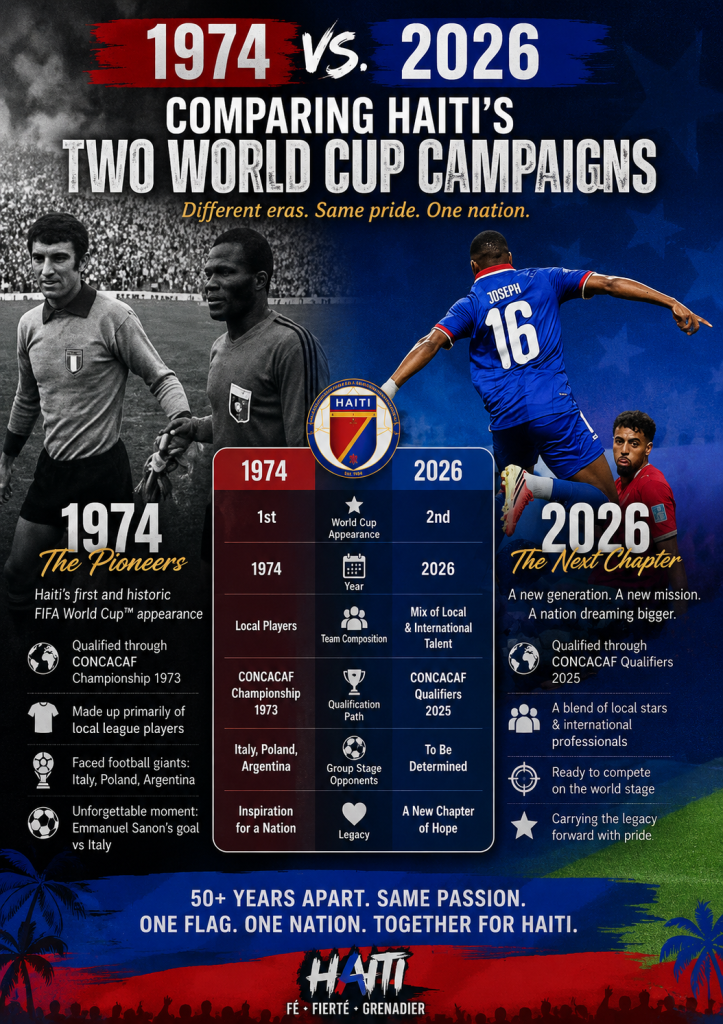
Separated by 52 years, two oceans of footballing change, and an entire diaspora’s worth of migration, Haiti’s two FIFA World Cup campaigns — 1974 in West Germany and 2026 across the United States — offer a fascinating case study in how a small footballing nation’s fortunes can shift, and how some things never change. Haiti have appeared twice at the FIFA World Cup, in 1974 and in 2026, and both times they were eliminated at the group stage without winning a match. But beneath that shared headline lies a far more nuanced story. Here is the full statistical and contextual comparison.
Group Draws: Two Brutal Tests
1974 — Group 4 (West Germany, Italy, Argentina, Poland… minus West Germany): Group 4 of the 1974 FIFA World Cup pitted Italy (Pot 1, Western Europe), Poland (Pot 2, Eastern Europe), Argentina (Pot 3, South America), and Haiti (Pot 4, Rest of the World) against one another. It was, by any measure, one of the toughest groups in tournament history — Italy were the reigning runners-up from the previous World Cup, Argentina featured Mario Kempes, and Poland, inspired by Grzegorz Lato, would go on to finish third overall.
2026 — Group C (Brazil, Morocco, Scotland): Haiti’s modern return was no gentler. They were drawn against five-time champions Brazil, North African powerhouse Morocco, and a resurgent Scotland making their first World Cup appearance since 1998. Both eras, then, share a defining trait: Haiti has never once been handed an easy group.
Head-to-Head Comparison: Match Results
| 1974 | 2026 | |
|---|---|---|
| Match 1 | Italy 3, Haiti 1 | Scotland 1, Haiti 0 |
| Match 2 | Poland 7, Haiti 0 | Brazil 3, Haiti 0 |
| Match 3 | Argentina 4, Haiti 1 | Morocco 4, Haiti 2 |
Head-to-Head Points
Since each individual match in a group stage is its own discrete contest, “head-to-head points” effectively mirrors overall group points in both campaigns:
- 1974: Haiti finished with 0 points from 3 matches (0 wins, 0 draws, 3 losses).
- 2026: Haiti also finished with 0 points from 3 matches (0 wins, 0 draws, 3 losses) — a result formalized once Morocco closed out a 4-2 win in the final group match in Atlanta.
Verdict: Dead even. Across 52 years and two completely different generations of players, Haiti’s points return at the World Cup has not improved by a single point.
Head-to-Head Goal Difference (vs. group opponents only)
- 1974: 2 goals scored, 14 conceded → -12 goal difference
- 2026: 2 + 0 + 2 = 4 goals scored… wait — let’s be precise. Haiti scored 1 vs Scotland? No — Haiti scored 0 vs Scotland, 0 vs Brazil, and 2 vs Morocco. Total: 2 goals scored, 8 conceded → -6 goal difference
Verdict: 2026 is a clear improvement. Haiti conceded only 8 goals across the modern campaign compared to 14 in 1974, halving their defensive damage despite facing arguably similar (if not tougher, given Brazil’s pedigree) calibre of opposition.
Head-to-Head Goals Scored (vs. group opponents only)
- 1974: 2 goals scored across the tournament — both netted by Emmanuel Sanon, against Italy and Argentina respectively.
- 2026: 2 goals scored — both arriving in the final, already-academic match against Morocco: Lenny Joseph’s opener in the 10th minute and Wilson Isidor’s spectacular long-range strike in the 43rd minute.
Verdict: Tied at two. Remarkably, across two World Cups spanning more than half a century, Haiti has scored exactly two goals each time. Indeed, Haiti had scored only two goals in its entire World Cup history prior to the Morocco match — and matched that tally within a single half of their 2026 finale.
Overall Goal Difference (Tournament-wide)
These figures are identical to the head-to-head numbers above, since Haiti’s entire group-stage campaign in both years consisted only of group matches with no further fixtures played.
- 1974: -12 (2 scored, 14 conceded)
- 2026: -6 (2 scored, 8 conceded)
Verdict: 2026 nearly halves the goal-difference deficit of 1974, a meaningful defensive improvement even allowing for the fact that both campaigns ended without a win.
Overall Goals Scored (Tournament-wide)
Identical to the head-to-head figures: 2 goals in 1974, 2 goals in 2026. The symmetry is one of the more remarkable footnotes in Haitian football history — two completely different generations of players, 52 years apart, finishing with the exact same tally.
Fair Play Score
This is where the two campaigns diverge most sharply in terms of available data. FIFA’s team conduct (“fair play”) score is used as a tiebreaker for group standings and third-place rankings when head-to-head and overall records are tied — but this metric, in its modern form (based on yellow/red cards and other disciplinary records), was not a recognized part of World Cup tiebreaker procedure in 1974. Disciplinary statistics from the 1974 tournament exist in limited archival detail, but no comparable “fair play score” was compiled or published for that era in the way FIFA does today. Since Haiti finished bottom of their respective groups in both tournaments without needing a tiebreaker, fair play scores were not a deciding factor in either campaign — but a direct numerical comparison between the two eras isn’t possible due to the absence of a standardized scoring system in 1974.
FIFA World Ranking After the Tournament
This is the most important caveat of the entire comparison: the FIFA World Ranking system did not exist in 1974. FIFA did not introduce its official Men’s World Ranking until August 1992, meaning there is no historical FIFA ranking figure for Haiti immediately following the 1974 World Cup. Haiti’s footballing standing at that time would instead have been judged informally, via regional reputation — Haiti were regarded as roughly the third-strongest team in CONCACAF behind Mexico and arguably Costa Rica during this era.
For 2026, however, the picture is precise and well-documented:
- Haiti entered the tournament ranked 83rd in the FIFA Men’s World Ranking, the second-lowest ranked team in the entire 48-team field, behind only New Zealand at 85th.
- After their opening defeat to Scotland, Haiti dropped to 85th, becoming the lowest-ranked team in the entire tournament — below New Zealand.
- By the time Haiti faced Brazil, they sat 85th with 1,277.67 points, having briefly held 83rd before the Scotland loss pulled them down. Haiti’s all-time highest ranking was 38th, achieved in January 2013, while their lowest-ever ranking was 155th, recorded in April 1966.
Verdict: Not directly comparable, since no ranking existed in 1974 — but the 2026 squad entered the tournament as the lowest- or second-lowest-ranked team in the entire 48-team field, underscoring just how heavily Haiti punched above its statistical weight simply by qualifying for, and competing credibly in, the toughest possible group.
Summary Table
| Metric | 1974 | 2026 |
|---|---|---|
| Group Stage Points | 0 | 0 |
| Wins–Draws–Losses | 0–0–3 | 0–0–3 |
| Goals Scored | 2 | 2 |
| Goals Conceded | 14 | 8 |
| Goal Difference | -12 | -6 |
| Fair Play Score | Not formally tracked | Not a deciding factor |
| FIFA World Ranking (post-tournament) | N/A (system didn’t exist) | 85th |
Final Takeaway
The numbers tell a story of remarkable consistency layered with quiet improvement. Haiti’s two World Cup campaigns produced identical points totals (zero) and identical goal tallies (two), yet the 2026 vintage conceded almost half as many goals as their 1974 predecessors did against, arguably, an even more star-studded gauntlet of opposition. Both Haitian goals in 2026 came in a thrilling, ultimately academic 4-2 defeat to Morocco — fittingly mirroring 1974, when both of Haiti’s goals also came from a single, iconic source: Emmanuel Sanon.
What separates the two campaigns most is not the scoreboard, but the context surrounding it. The 1974 squad were entirely homegrown, having risen through Haiti’s domestic league before facing the world. The 2026 squad, assembled largely from the European-based diaspora, represented a fundamentally different model of national team building — one shaped by 52 years of Haitian migration to France, the United States, and beyond. Whether judged on the pitch or through the broader lens of footballing identity, both Haitian sides left the World Cup having lost every match, yet both also left having mattered: 1974 for Sanon’s goal against Dino Zoff, and 2026 for a chaotic, four-goal thriller in Atlanta that gave a new generation of Haitian fans something to sing about.


