



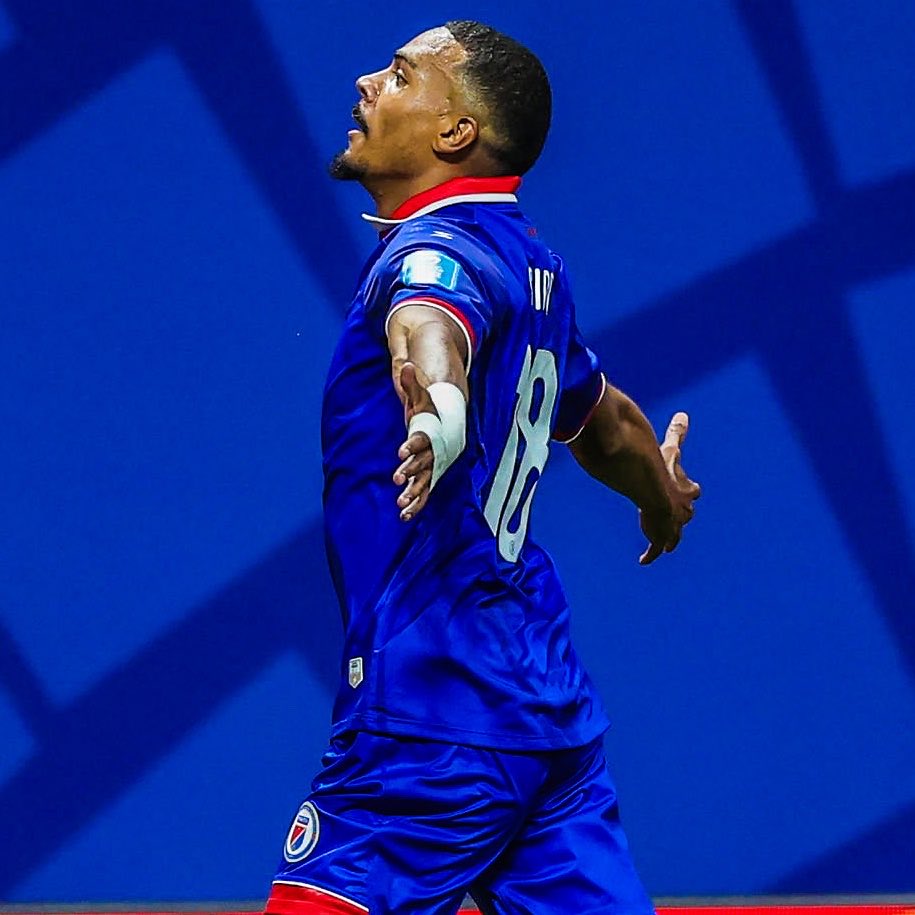
An expert profile of the Premier League forward whose international switch reshaped Haiti’s attack ahead of its historic 2026 World Cup return
Introduction
Few stories at the 2026 FIFA World Cup capture the modern complexity of national identity in football quite like that of Wilson Isidor. A Premier League striker who came through one of France’s finest academies and represented his country of birth at every youth level, Isidor made the deeply personal choice — just months before the tournament — to wear the colours of Haiti instead. The decision turned him from a promising Sunderland forward into one of the most talked-about additions to Les Grenadiers’ historic World Cup squad, and by the group stage’s final round, he had already delivered one of the goals of the tournament.
Early Life and Background
Wilson Isidor was born on 27 August 2000 in Rennes, France. His parents are from Haiti, and he is of Haitian and Malagasy descent through his mother’s side. He came up through SC Le Rheu before joining the academy of Stade Rennais FC in 2009, where he stayed until 2018 — the same storied Rennes academy that has produced a string of French internationals. He represented France at youth level, from U-17 to U-20, and was once considered a potential option for the senior French national team.
Climbing the Ladder: The Club Career
Monaco (2018–2021). Isidor made his professional debut with Monaco on 11 November 2018, in a 4–0 Ligue 1 loss to Paris Saint-Germain. The move from Rennes to the principality club put him in one of France’s most productive academies for attacking talent. To gain experience, he had loan spells in the Championnat National with Laval in the 2019–20 season and with Bastia-Borgo in 2020–21, where he was named the Championnat National’s revelation of the season — a breakout campaign that confirmed his goal-scoring potential outside the top flight.
Lokomotiv Moscow (2022–2023). On 22 January 2022, Isidor signed a 4.5-year contract with Russian club Lokomotiv Moscow. His start there was sensational: he scored at least once in each of his first six games in the Russian Premier League, matching a record for the most consecutive games with a goal at the start of a league career, and was named the Russian Premier League’s Player of the Month for April 2022.
Zenit St. Petersburg (2023–2025). Isidor was transferred to Zenit, where he went on to win three titles across his career: the Russian Premier League in 2023/24, the Russian Super Cup in 2024/25, and the Russian Cup in 2023/24.
Sunderland (2024–present). Isidor initially joined Sunderland on loan from Zenit in August 2024, scoring nine goals before the club triggered the purchase option. On 1 February 2025, he signed a permanent deal with Sunderland on a contract running until the summer of 2028. The move proved transformative for both player and club. On 9 May 2025, Isidor scored in Sunderland’s 2–1 away win over Coventry City in the first leg of their Championship play-off semi-final, helping the club push towards promotion. Sunderland’s promotion push succeeded, and Isidor was there to mark the club’s top-flight return in style: on 16 August 2025, he scored Sunderland’s third goal in a 3–0 win over West Ham on the club’s return to the Premier League. In his first season back in England’s top division, he recorded six goals in the 2025/26 Premier League campaign.
The International Crossroads: Choosing Haiti
For years, Isidor’s international future appeared tied to France. That changed in early 2026, as Haiti’s qualification for its first World Cup since 1974 set off a wave of outreach to diaspora-born talent. After months of public campaigning by Haitian fans on social media urging him to join Les Grenadiers, Isidor announced his decision to switch allegiance, just three months before the tournament. In a clip posted by the Haitian Football Federation, he said in Creole: “You asked for me. You believe in me. You waited for me. Today, I come to tell you: here, I am.”
Isidor explained the personal weight of the choice: “My grandpa and my dad were born in Haiti,” he said. “Because I’m French, it was difficult to make a choice. I had to choose between my mum and my dad! I’m really happy with that choice. I’m learning a lot about the country and learning about the culture.” He was named in Haiti’s squad for friendly matches against Tunisia and Iceland in March 2026, and the switch carried symbolic weight at club level too: by representing Haiti, Isidor became the first Haitian player to have played for Sunderland.
Announcing the decision, Isidor wrote on social media: “I am proud to now be part of the national team and be able to bring honour to our people, to our nation. Together, we have the opportunity to make history and experience great adventures.” On 15 May 2026, he was officially included in head coach Sébastien Migné’s 26-man squad for the FIFA World Cup.
Performance at the 2026 FIFA World Cup
Drawn into a daunting Group C alongside Brazil, Morocco, and Scotland, Haiti’s first World Cup appearance in 52 years was always going to be a steep test — and Isidor was thrust straight into the heart of it as the team’s lead striker.
Match 1 — Scotland 1-0 Haiti (Foxborough/Boston, June 13/14). Isidor started Haiti’s historic World Cup return, but the Grenadiers were undone by a scrappy McGinn rebound, falling to defeat in their first World Cup match since 1974.
Match 2 — Brazil 3-0 Haiti (Philadelphia, June 19). Haiti suffered another defeat, this time 3-0 to Brazil, confirming their elimination from the tournament before the final group game had even been played.
Match 3 — Morocco vs Haiti (Atlanta, June 24). With qualification already gone, Isidor delivered one of the standout individual moments of the entire tournament. After Lenny Joseph’s early opener deflected in off the Moroccan goalkeeper in the 10th minute and Achraf Hakimi leveled for Morocco in the 39th, Isidor restored Haiti’s lead with a sublime long-range strike — a genuine contender for goal of the tournament. The Sunderland forward collected the ball on the right edge of the penalty area, shifted it onto his right foot to create space, and unleashed an unstoppable rocket that flew across the goal and into the top-left corner, sending the Mercedes-Benz Stadium crowd into a frenzy. Morocco’s Ismael Saibari restored parity in stoppage time, sending the teams in level at 2-2 at the break, before Haiti’s Josué Casimir struck again early in the second half to put Les Grenadiers back in front.
(Note: At the time of writing, the Morocco–Haiti match was still in progress in the second half. Readers should check the latest score for the confirmed full-time result.)
What Isidor’s World Cup Means
Whatever the final scoreline against Morocco, Isidor’s tournament will be remembered as a personal triumph layered onto a broader national story. A Premier League striker who could easily have spent his career chasing a France cap instead chose to write Haitian football’s next chapter — and did so by scoring one of the most memorable individual goals of the entire 2026 World Cup group stage.
For Haiti, already eliminated by the time he struck that rocket into the top corner, Isidor’s goal was about something larger than the table: proof that the influx of elite diaspora talent — Isidor, Bellegarde, Casimir, Joseph and others — has given Les Grenadiers a ceiling far higher than anything the nation has had access to since 1974. Whether Isidor continues with Haiti beyond this tournament or simply treats it as a career-defining chapter, his World Cup debut has already secured him a lasting place in the country’s footballing memory.


