



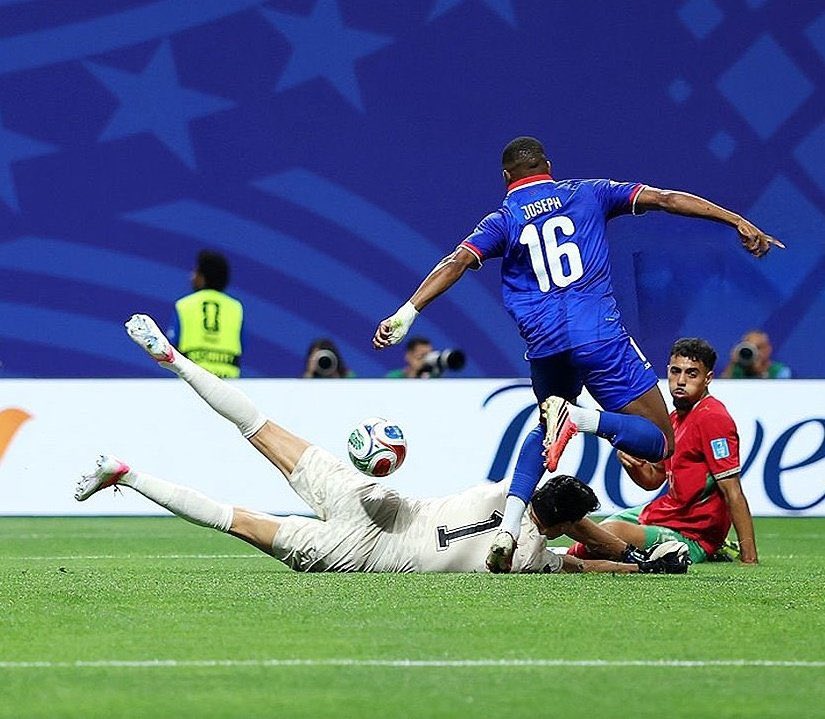
An expert breakdown of the Haitian forward’s journey from French lower-league football to the biggest stage in the sport
Introduction
Of all the storylines woven through Haiti’s first World Cup appearance in 52 years, few capture the spirit of “Les Grenadiers” quite like that of Lenny Joseph. A forward who spent the best part of a decade grinding through France’s lower divisions before ever wearing the Haitian crest, Joseph arrived at the 2026 FIFA World Cup as a first-time call-up — and within three matches, etched his name into the history books by scoring Haiti’s first-ever goal of the tournament.
Early Life and Background
Lenny Joseph was born on 12 October 2000 in Paris, France, and holds dual French-Haitian citizenship, standing 1.83 metres tall and playing predominantly with his right foot. He was born in France to a Haitian father and a DR Congolese mother, which made him eligible to represent either France or Haiti at international level. Like so many of his current Haiti teammates, Joseph’s path to international football reflects the realities of the Haitian diaspora: a footballer raised and developed entirely within the French system, who ultimately chose to represent the land of his father’s heritage.
Climbing Through the Ranks: The Club Career
Joseph’s professional journey was far from a fast-tracked academy rise. It was built, instead, on patience and steady improvement through some of French football’s less glamorous corners.
Le Puy and Boulogne (2019–2021). His career began in the lower tiers of French football with Le Puy Foot 43, where he developed into a prolific scorer in the National 2 division, netting 10 goals across 18 appearances between 2018 and 2021. He also spent time with the reserves of Boulogne during this period. It was a breakout run in the 2020-21 Coupe de France — France’s national cup competition, famous for giving amateur and lower-league clubs a shot at giant-killing — that first turned heads. He reached the last 16 of the French Cup with Le Puy that season thanks to standout performances, which attracted the attention of top-flight club Metz.
FC Metz (2021–2023). Joseph signed a professional contract with Metz in the summer of 2021 and made his professional debut in a 3–3 Ligue 1 draw with Lille on 8 August 2021. He went on to make his top-flight debut in Ligue 1 and contributed three goals in 29 Ligue 2 matches the following season, after the club’s relegation. In total, he recorded one goal in three Coupe de France appearances with Metz. Across his two years with Metz, he made 40 appearances in total, scoring four goals, playing in both the first and second divisions of French football.
Grenoble Foot 38 (2023–2025). Joseph signed for second-division side Grenoble in the summer of 2023, and over the following year and a half played 56 games, scoring eight goals and recording eight assists. It was a productive, if unspectacular, stint that nonetheless kept building his case for a move to a higher level.
Ferencvárosi TC (2025–present). On 20 January 2025, Joseph was signed by Hungarian league club Ferencvárosi TC — Hungary’s most successful and storied club, commonly known as Fradi. The move marked his first stint abroad, joining the reigning Nemzeti Bajnokság I champions as a centre-forward. His integration was gradual at first, but he soon became a regular contributor. In the 2025–26 season, Joseph made 25 league appearances scoring seven goals and adding one assist, while also featuring 12 times in the Europa League, scoring twice and assisting twice. On 9 May 2026, he won the 2025–26 Magyar Kupa (Hungarian Cup) with Ferencváros, beating Zalaegerszegi TE 1–0 in the final at the Puskás Aréna — the first major trophy of his career.
The Call-Up: Joining Les Grenadiers
For years, Joseph’s name was absent from Haiti’s national team conversation. That changed dramatically in 2026, as coach Sébastien Migné assembled a World Cup squad built largely around the diaspora. In May 2026, Joseph was called up for the FIFA World Cup to represent the Haiti national team for the first time, joining a wave of other first-timers. He was one of the notable first-time call-ups in Haiti’s roster, alongside midfielder Dominique Simon, both players competing for top-tier clubs in Europe — Joseph at Ferencvárosi TC in Hungary and Simon at FC Tatran Prešov in Slovakia.
Joseph made the final 26-man squad as a 25-year-old forward, wearing the number 16 shirt for Les Grenadiers. It capped an unlikely rise for a player who, just a few years earlier, had been grinding out minutes in France’s third and fourth tiers.
Performance at the 2026 FIFA World Cup
Haiti were drawn into a brutal Group C alongside Brazil, Morocco, and Scotland — arguably the toughest possible return to the World Cup stage after a 52-year absence.
Match 1 — Scotland 1-0 Haiti (Foxborough, June 13/14). Joseph started in Haiti’s historic World Cup return after 52 years away, but the Grenadiers fell to a narrow defeat, beaten by a John McGinn rebound after a Ché Adams effort was saved.
Match 2 — Brazil 3-0 Haiti (Philadelphia, June 19). A clinical Brazilian display, led by Vinícius Júnior and Matheus Cunha, left Haiti without a goal and already eliminated from World Cup contention after two matches.
Match 3 — Morocco vs Haiti (Atlanta, June 24). Needing nothing but pride, Joseph delivered the moment Haitian football had craved for over half a century. Joseph received an assist from Jean-Kévin Duverne on the right flank and was waiting at the center of the box to knock the ball in — Haiti’s first goal of the 2026 World Cup. The strike came in the 10th minute, deflecting in for what was recorded as an own goal off Morocco goalkeeper Yassine Bounou, but it was Joseph’s effort that forced the moment. Prior to that goal, Haiti had scored only two goals in its entire World Cup history — and Joseph’s effort meant the team matched that tally inside a single half. The match itself turned into an instant classic, with Morocco’s Achraf Hakimi equalizing before Wilson Isidor restored Haiti’s lead with a stunning long-range strike, only for Ismael Saibari to level it again for Morocco in stoppage time, sending the sides in level at 2-2 at the break.
(Note: At the time of writing, the Morocco–Haiti fixture was still unfolding into the second half, with the final result not yet determined. Readers should check the latest score for the full-time outcome.)
What Joseph’s Tournament Means
Even with Haiti’s group-stage exit confirmed before a ball was kicked against Morocco, Joseph’s contribution carries real weight in the context of Haitian football history. His goal against Morocco ended a 52-year wait for the nation to find the net at football’s biggest tournament outside of the legendary 1974 campaign, and did so on a global stage shared with the likes of Brazil’s Neymar and Vinícius Júnior.
For a player who spent his early twenties working his way up through France’s National 2, Ligue 2, and the Hungarian top flight, scoring at a World Cup represents the unlikely peak of a career built on persistence rather than precocity — and a moment that will be remembered fondly by the Haitian diaspora regardless of where Les Grenadiers finish in the final standings.


